Mahasamar
Mahasamar (9 Volumes) by Narendra Kohli is a monumental literary work on the epic Mahabharata.
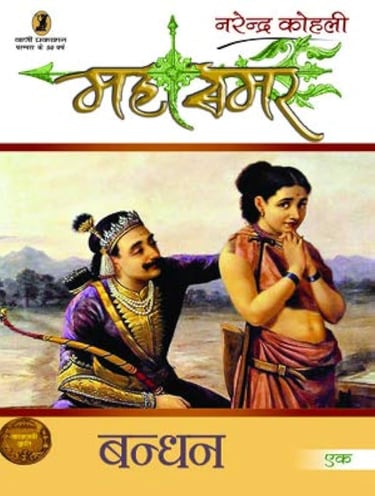
Mahasamar (9 Volumes) by Narendra Kohli is a monumental literary work on the epic Mahabharata.
Just read the First Volume "Bandhan" in Hindi.
Through these interconnected lives, Bandhan becomes more than a retelling—it becomes a mirror for our times. It compels us to ask:
• When does duty become dogma?
• Are traditions serving humanity, or enslaving it?
• Can sacrifice be truly virtuous if it leads to injustice?
The core message is timeless:
True dharma is not blind obedience, but conscious action rooted in wisdom and compassion.
The greatest bondage is not that of fate or enemies, but of the mind—when it refuses to question outdated norms.
Humanity need to recognize that:
• Freedom is not rebellion, but understanding.
• Duty is not submission, but courage to act justly.
• And sacrifice is noble only when it uplifts, not when it destroys
Bandhan is not merely the beginning of a war—it is the unraveling of the emotional, moral, and cultural bonds that eventually demand a war. This is not just the story of kings and queens—
It is the story of every human being bound by invisible chains, longing for purpose, clarity, and inner freedom.
An Excellent Read.
Mahasamar- Volume - 2 - Adhikaar
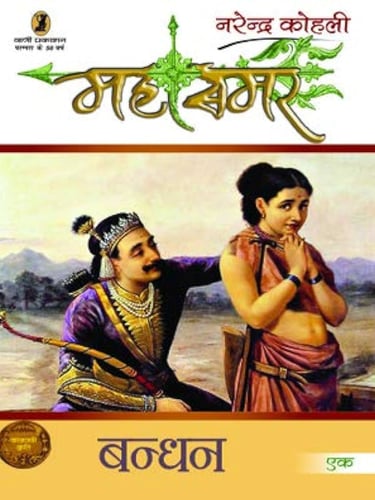
Mahasamar- Volume - 1 - Bandhan (बंधन)
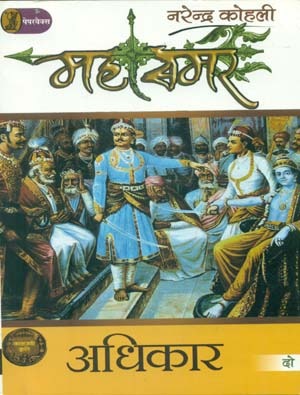
After 1st Volume "Bandhan", Adhikar (Vol-2 of Mahasamar ) was an amazing reading journey.
Adhikar is the second volume in Narendra Kohli’s monumental Mahasamar series of 9 Volumes. It is a philosophical and psychological exploration of Adhikar (authority, right, entitlement, or legitimacy) and how individuals relate to duty, power, and dharma.
Adhikar explores the concept of rightful authority. It asks:
• Who has the right to rule?
• Is authority based on birth, merit, moral character, or divine will?
• What responsibilities come with power?
Adhikar is not a privilege—it is a duty. True adhikar is earned by character, sacrifice, and moral integrity, not merely by seniority, caste, or inheritance.
The characters are often torn between personal desires and dharma (righteous duty):
Dhritarashtra and Gandhari are portrayed as figures who represent the complexities of power, duty, and moral compromise.
• Yudhishthira is chosen as the crown prince not because he wants power, but because he is morally capable of bearing the responsibility.
• Kunti’s life is a constant balancing act—between maternal love and royal duty, between personal grief and national responsibility.
Power is described not as dominance, but as the moral burden to serve others:
• Krishna represents a divine figure who understands adhikar as service, not control.
• Drona and Drupada represent two contrasting forms of power—one based on loyalty and hierarchy, the other on revenge and pride.
Author seems to be asking: Does might make right? Or does dharma define authority?
A key question posed throughout the book is:
“When the path is unclear, how do you act rightly?”
Discourse of Krishna, Vidur, Akrur, Bhishma etc show that dharma is not fixed—it is contextual, evolving, and requires deep awareness.
The book describes the traits of a leader:
• A leader is not driven by ambition, but by a sense of service.
• Leadership must be earned, not taken.
• True kingship involves sacrifice, restraint, and the ability to uphold justice even when it hurts.
Yudhishthira embodies this ideal, while the Kauravas represent a corruption of adhikar—a desire for power without responsibility.
Adhikar questions the ethics of leadership, the burden of morality, and the human cost of dharma.
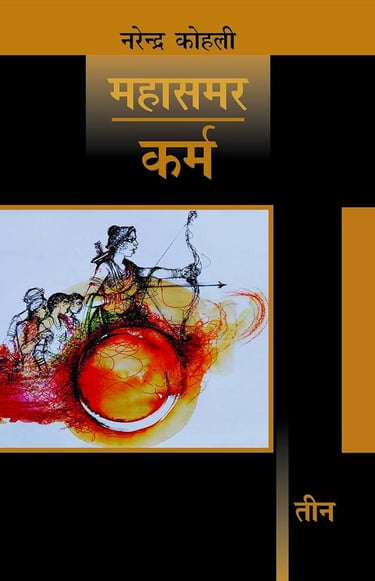
Mahasamar- Volume - 3 - Karma (कर्म)
Narendra Kohli, one of the most formidable voices in modern Hindi literature, continues his epic retelling of the Mahabharata in Karma, the third volume of his magnum opus, Mahasamar. He masterfully weaves together philosophy, politics, and human drama, grounding in realism and presenting the Pandavas as deeply human characters navigating treachery, fate, and duty.
The novel opens with a chilling depiction of Duryodhana and Shakuni’s conspiracy to eliminate the Pandavas by luring them to Varanavat under the pretense of a diplomatic visit. The house made of lac—Lakshagrah—is described not merely as a physical trap, but as a symbol of how political power is weaponized through manipulation and deceit.
Kohli presents the event with psychological depth. The Pandavas’ growing suspicion, Vidura’s cryptic warning through a coded message, and Pandavas cautious intellect lend realism to the escape. The actual burning of the Lakshagrah is written with cinematic intensity. Bhima emerges here as the heroic protector—his strength and courage ensuring the family's survival. Yet, Kohli doesn’t reduce him to brute force alone; Bhima is shown as emotionally invested, particularly in his protectiveness toward Kunti.
The escape into the forest is symbolic of the Pandavas’ transition—from princes sheltered within the palace walls to exiled warriors learning to navigate a world of danger, disguise, and dharma.
The forest episode leads to an emotionally rich interlude—Bhima’s encounter with Hidimba. Kohli humanizes Hidimba beyond her traditional portrayal. She is not just a rakshasi, but a woman with intelligence, dignity, and agency. Her attraction to Bhima is carnal as well as emotional. Bhima, too, is shown as conflicted—a warrior who is also a man with tenderness and responsibility. Their marriage, though brief, is painted with grace. The birth of Ghatotkacha is not rushed; instead, it is shown as the continuation of a karmic cycle.
The swayamvar of Draupadi is among the most dramatic highlights of the novel. Kohli portrays Draupadi not as a passive prize but as a woman of will, caught in the politics of her father Drupada's ambitions and Krishna’s divine plans. The tension builds masterfully as princes from across Bharatvarsha fail at the challenge, and then arrives the disguised Arjuna, accompanied by his brothers.
Arjuna’s success in the archery contest is met with quiet dignity. However, Kohli gives equal weight to Bhima’s role, especially in defending Draupadi’s honor from the aggressive suitors. The interplay between Arjuna and Bhima during this moment of crisis reflects the unique blend of strategy and strength that defines the Pandavas. Kohli also handles the emotional complexity of Draupadi’s polyandrous marriage with maturity. Rather than focusing on sensationalism, he frames it within dharma, destiny, and Krishna's subtle orchestration of events.
The Pandavas’ return to Hastinapur, marks a pivotal moment in the narrative. Now no longer just survivors, they return as warriors who have proven themselves in exile. Their journey is accompanied by Krishna, who by now is established as a divine presence and strategist par excellence. Krishna’s conversations with the Pandavas, especially Yudhishthira and Arjuna, are filled with philosophical undertones—about karma, destiny, leadership, and righteousness. Kohli portrays Krishna as a visionary statesman who guides with wisdom, not force.
This return is not a triumphant homecoming, but the calm before the next political storm. Author makes it clear: the Mahasamar (great war) is still to come, but the seeds of conflict, loyalty, and dharma are already sown.
Karma is aptly titled—it is a volume about action, responsibility, and consequence. Narendra Kohli’s literary style is crisp, philosophical, and unafraid to probe difficult moral questions. The burning of the Lakshagrah, Bhima’s marriage to Hidimba, the dramatic swayamvar of Draupadi, and the return of the Pandavas are not just plot points—they are profound moments that reflect the unfolding of cosmic and personal destinies.
Kohli’s gift lies in his ability to breathe new life into an ancient epic, making it relevant for modern readers. Karma does not merely retell—it reinterprets, reinvigorates, and reframes the Mahabharata for the thinking reader.
Mahasamar- Volume - 4 - Dharma (धर्म)
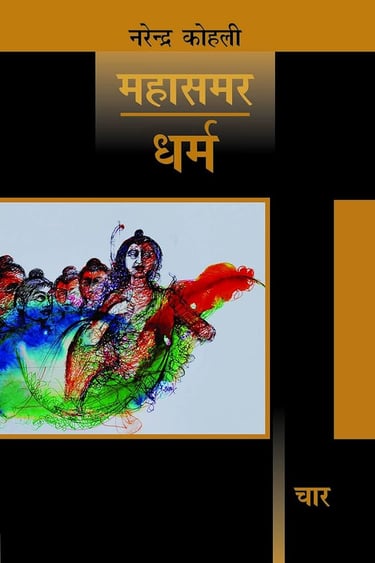
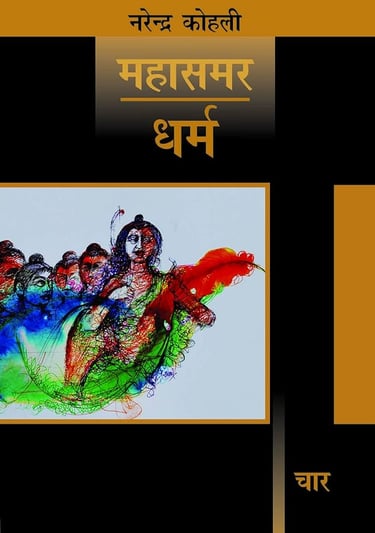
Dharma (Vol-4 of Mahasamar), continues Narendra Kohli’s ambitious retelling of the Mahabharata, placing emphasis on the theme of dharma — righteousness, moral duty — and the complex dilemmas its characters face. This volume covers the stage when the Pandavas have been given Khandavaprastha as their kingdom, transforming a barren, lawless forest region into Indraprastha. It also moves forward to the dice (dhyut) episode, the loss of all their possessions, their humiliation, Draupadi’s disrobing, and eventually the twelve years vanavas (forest exile). The narrative interrogates whether certain actions—conforming to societal, familial, or political expectations—can be justified as dharma (just duty), even when they lead to suffering, injustice, or inner conflict.
One of the most compelling aspects of Dharma is how it does not treat dharma as a simple, one dimensional ideal. The dilemmas: when Yudhishthira gambles, is he fulfilling dharma as a dutiful son, as a king, or betraying ethical responsibility to his brothers and wife? The conflicts—between personal conscience, social duty, and political necessity—are drawn sharply. It sometimes softens or “justifies” certain questionable actions of Yudhishthira in order to uphold his image as the ideal king. For example, the gambling episode is presented with much moral ambivalence, perhaps too much emphasis on external coercion or duty, less on personal responsibility.
The restoration of Khandavaprastha, the description of arid land, lawlessness, and the challenge of governance, not to mention build up of political intrigue and plot development with Kauravas and Shakuni, bring out the textures of the period. The narrative does not simply accelerate from one mythic incident to another, but shows steps in the transformation of the political order and moral strain. Because it is a retelling and adaptation, some supernatural elements or events are modified, downplayed or interpreted differently. The traditional epic mythic elements have not been kept intact, but are written on a more natural plane.
One of the more understated yet symbolically rich portions of this volume is Arjuna’s self-imposed exile. Bound by a vow that any brother who intrudes upon another's privacy with Draupadi must go into exile for twelve years, Arjuna silently accepts the consequence when he accidentally walks in on Yudhishthira and Draupadi. Rather than frame this as a minor incident, the incident is used to reflect on personal integrity, the burden of vows, and the silent cost of upholding shared ideals. Arjuna’s journey becomes more than physical—it is an internal reckoning, where questions of love, solitude, and self-discipline quietly unfold. During this exile, Arjuna encounters Ulupi, the Naga princess, and later Chitrangada, the warrior princess of Manipur. These relationships, while sometimes seen as diversions in the epic, are treated here with subtlety.
The Rajsuya Yagya performed by Yudhishthira is a centerpiece of the volume. The ceremony is infused with spiritual and philosophical meaning, showing it not merely as a political act, but as a dharmic declaration of righteous leadership. The Pandavas' victory over multiple kingdoms and the acknowledgment of their sovereignty set the tone for a new political order in Bharat. However, Krishna’s role in ensuring Shishupal’s death during the Yagya adds a layer of divine inevitability to the story. Shishupal's relentless insults and Krishna’s calm composure are wonderfully depicted, culminating in the fateful moment where the Sudarshan Chakra puts an end to the slanderer. It marks the moment where dharma asserts itself, even violently, when crossed beyond reason.
One of the most compelling episodes in this volume is Duryodhan’s visit to Indraprastha. The newly constructed city, built by the divine architect Maya, is a symbol of Dharma, prosperity, and the Pandavas’ competence. The description of Indraprastha is more than just grandeur — it is a representation of just governance and the fruits of virtue. Duryodhan’s awe quickly turns into burning jealousy. The now-famous scene where he falls into an illusory pool, mistaking crystal-clear water for a crystal/marble floor is narrated with a blend of subtle irony and psychological depth. Instead of simply mocking him, the moment is used to underline Duryodhan’s deep-seated insecurity — a prince who has everything, yet feels eternally threatened.
The descent into darkness begins with the infamous game of dice, and here, Kohli’s writing shines in its intensity and philosophical complexity. The trap laid and manipulation by Shakuni, the compulsion of Yudhishthira, and the gradual destruction of Dharma in the court of Hastinapur are laid bare. But it is the episode of Draupadi’s humiliation in the court that becomes the moral nadir of this volume Draupadi’s voice — her debate in Dhritarashtra’s court is a piercing cry for justice, logic, and dharma. Her questions are sharp: Was she staked before or after being lost? Did Yudhishthira have the right to gamble her away after losing himself? These are not mere rhetorical questions but a philosophical challenge to the foundation of power, patriarchy, and justice in the Kuru court. Kohli handles the scene with sensitivity and gravity, showing how none of the elders — Bhishma, Drona, Kripacharya — rise to defend her. Only Vidur and Vikarn spoke for Draupadi and Bhim took vow of revenge and later Gandhari rescues her daughter in law along with Pandavas. The silence of the wise is portrayed as a far greater sin than the cruelty of the wicked. This moment becomes the heart of the volume — where the collapse of dharma is fully exposed.
The author refuses to present easy answers to act of good vs evil. Many incidents that in the mainstream retelling are clearly villainous are given shaded motivations or complex causation here. Mahasamar Volume 4 captures a civilizational turning point with grandeur, psychological insight, and philosophical depth. Narendra Kohli doesn’t just retell the Mahabharata — he reinterprets it for our times, showing that the dilemmas of power, justice, and dharma are eternal.
Mahasamar- Volume - 5 - "Antral" (अंतराल)
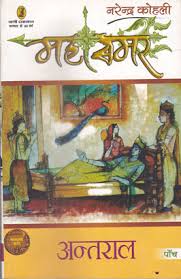
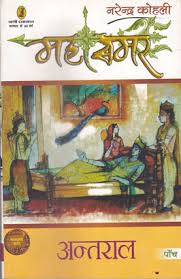
In Antaral, the fifth volume of Narendra Kohli’s epic retelling Mahasamar, the narrative enters a crucial phase marked by the thirteen-year exile of the Pandavas. Rather than treating this period merely as a pause between wars, Kohli transforms exile into a space of ideological, psychological, and spiritual testing. Antaral thus becomes a meditation on endurance, transformation, and the silent preparation that precedes great upheaval.
The forest exile provides the canvas on which Kohli explores the inner evolution of the Pandavas. The hardships of vanvaas strip them of royal identity and force them into confrontation with vulnerability and restraint. Yudhishthira’s moral rigidity is tested against survival, while Draupadi’s suppressed rage and sense of injustice lend the narrative an undercurrent of unresolved tension. Kohli’s treatment of exile is not romantic; it is weary, demanding, and deeply human.
One of the most compelling strands of Antaral is Arjuna’s journey to obtain the divine weapons. Kohli presents this not as a triumphant quest alone, but as a rigorous trial of discipline and self-negation. Arjuna’s encounters with the gods and his acquisition of the divyastras symbolize the paradox of power—strength earned only through humility, isolation, and inner struggle. The author subtly questions whether divine weapons resolve conflict or merely postpone moral reckoning.
Bhim’s episodes inject a contrasting energy into the volume. His visit to Kubera’s mansion and the subsequent battle are rendered with both grandeur and irony. Kohli uses Bhim’s physical might to explore excess, temptation, and restraint, highlighting how strength without wisdom courts imbalance. Similarly, Bhim’s slaying of Jatasura is more than a heroic feat; it underscores the perpetual threat faced by the Pandavas even in supposed withdrawal, reminding the reader that exile offers no true refuge from destiny.
Throughout Antaral, Kohli’s prose remains controlled and reflective. Action, though present, is never gratuitous. Each encounter—whether divine, demonic, or internal—serves to deepen the philosophical texture of the narrative. Silence, waiting, and moral ambiguity dominate the volume, reinforcing the sense that this is a period of gestation rather than culmination.
While readers seeking the political intensity or battlefield drama of other volumes may find Antaral subdued, its importance within Mahasamar is undeniable. It forges the ethical and emotional groundwork for the inevitable war, demonstrating that the Mahabharata’s greatest battles are often fought long before weapons are raised.
In conclusion, Mahasamar Volume 5 – Antaral stands as a powerful exploration of exile as transformation. Narendra Kohli elevates this interlude into a profound study of patience, power, and preparedness, making Antaral one of the most introspective and philosophically resonant volumes of the series.
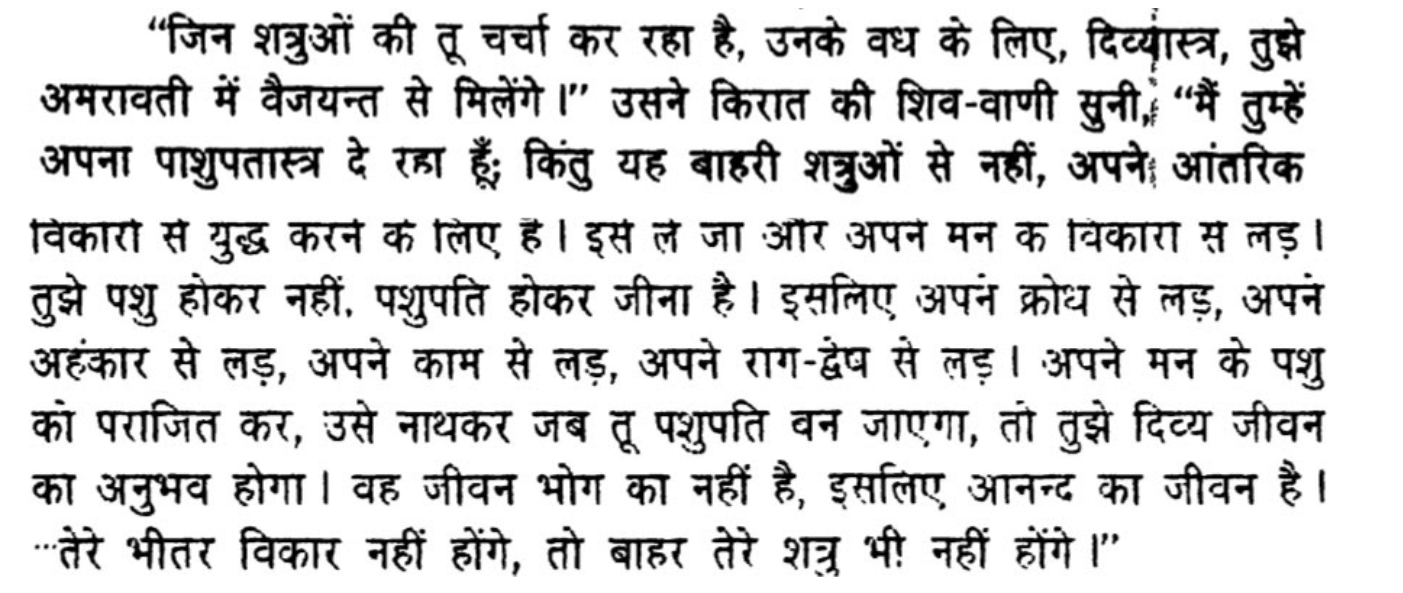
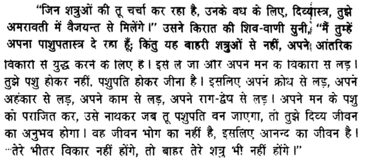
After a gap of few weeks of completing Vol-5, read Volume - 6 of Mahasamar "Prachann" by Narendra Kohli.
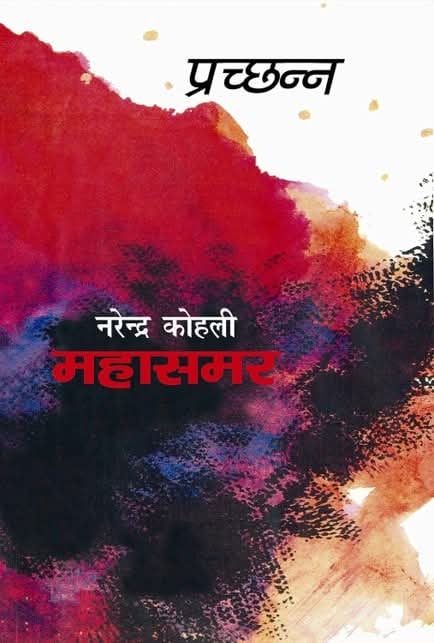
Prachann, the sixth volume of Narendra Kohli’s Mahasamar series, deepens the epic narrative by bringing forward the “hidden” tensions and turning points that shape the destiny of the Kuru lineage. Kohli weaves together several significant episodes, such as Duryodhan’s humiliating defeat at the hands of the Gandharvas in Dwaitwan forest (often referred to as the Ghosha-yatra Parva in the Mahabharata) was a major incident in the 12th year of the Pandavas' exile. Characterized by his humiliating capture, the flight of his intimate friend Karna, and his subsequent rescue by the Pandavas he sought to humiliate, which exposes both his arrogance and vulnerability. The dramatic abduction of Draupadi by Jayadrath, followed by her courageous rescue. These incidents are not merely retold as events; they are explored for their emotional and political consequences, revealing how pride, revenge, and honour continue to escalate the conflict beneath the surface.
A major portion of the book is devoted to the Agyatwaas (incognito exile) of the Pandavas in King Virat’s kingdom, which Kohli portrays with remarkable attention to psychological nuance. Each Pandava adopts a distinct role - Yudhishthira (Kanka): Acted as a Brahmin advisor and dice-playing companion to King Virata, Bhima (Vallabha/Ballava) Worked as a royal cook and wrestler, Arjuna (Brihannala): Disguised as a eunuch, he taught dance and music to Princess Uttara, Nakul (Granthika): Managed the royal stables and cared for horses, Sahadeva (Tantipala): Tended to the royal cows Draupadi (Sairandhri/Malini): Served as a hairdresser and maid to Queen Sudeshna. Kohli uses this phase to examine restraint, dignity, and the burden of concealment, showing how living in disguise tests their patience and unity even more than open conflict would.
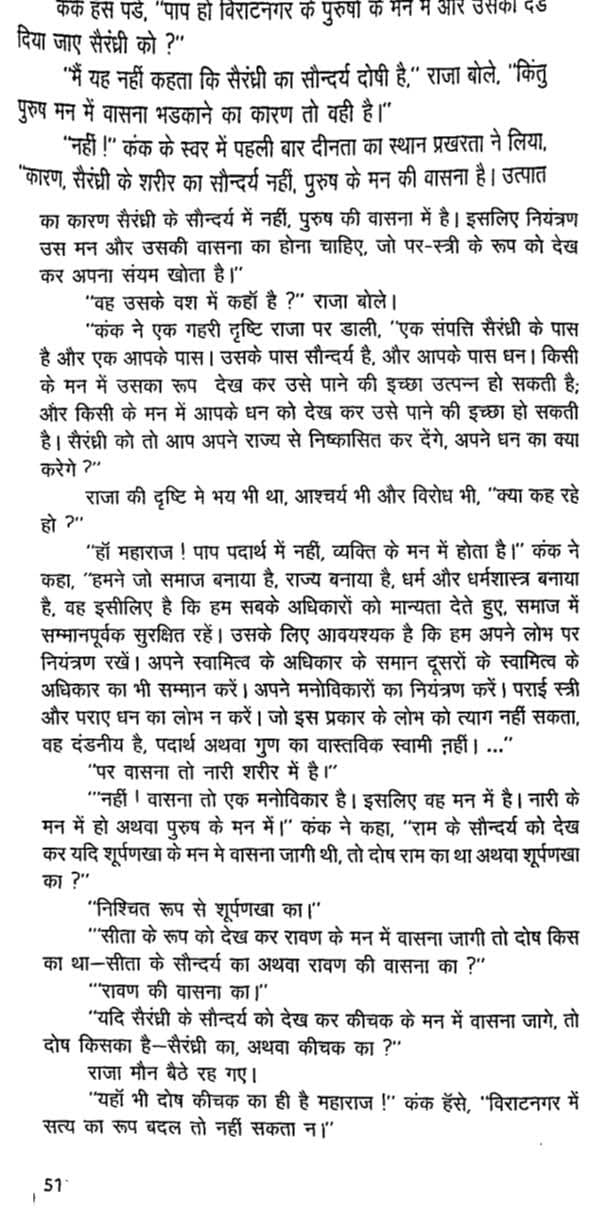
The episodes involving Keechak and Draupadi (as Sairandhri) form one of the most intense and emotionally charged segments of the novel. Keechak’s growing obsession with Sairandhri, his abuse of power, and Draupadi’s helplessness within the constraints of secrecy are portrayed with striking realism. Kohli delves into Draupadi’s anguish, dignity, and suppressed anger as she navigates harassment while being unable to reveal her true identity. The eventual plan to eliminate Keechak, carried out by Bhim, becomes a moment of both justice and catharsis. This sequence not only reinforces Bhim’s protective strength but also exposes the vulnerabilities faced by Draupadi, making it one of the most powerful explorations of gender, power, and honor in the narrative.
The narrative tension heightens with external threats to Matsya kingdom, particularly the attack by King Trigart, Susharma. During the Mahabharata period, King Susharma of Trigarta attacked the Matsya kingdom (King Virata). During the final days of the Pandavas' exile, Susharma took advantage of Keechaka's death and attacked Virata to steal cows. In this battle, Bhima defeated Susharma and took him hostage, but he was later released at the request of Yudhishthira Kohli vividly depicts the battle in which Matsyaraj, supported by four of the Pandavas, confronts the invading forces. This episode underscores the valor and strategic brilliance of the Pandavas even while they remain hidden, reinforcing the idea that true strength does not always seek recognition. At the same time, it highlights the fragile security of their incognito existence, where any misstep could reveal their identities.
Mahasamar- Volume - 6 - "Prachann" (प्रचन्न)
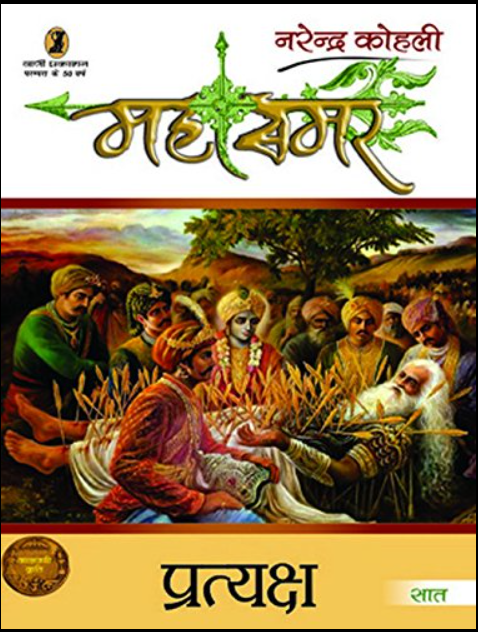
After "Prachann", Vol-6 of Mahasamar, read "Pratyaksha" Vol-7 of Mahasamar, "a saga" in hindi by Narendra Kohli, a modern, psychological retelling of the Mahabharata. This part focuses on the end of exile, hidden identity (Agyat Vaas), failed diplomacy, and the beginning of the Kurukshetra war, blending narrative with deep philosophical insight.
Narendra Kohli reinterprets the epic not just as mythology, but as a philosophical and psychological exploration of human actions, duty, and conflict.
Krishna strategically relocates the population from Mathura to Dwaraka to protect them from repeated invasions. Kohli portrays this as a masterstroke of leadership and statecraft, emphasizing Krishna’s role as a pragmatic ruler who prioritizes collective safety over attachment to land.
This volume details the crucial transition from peace efforts to inevitable war:
• The Pandavas seek support from allies after exile
• Diplomatic attempts by Krishna fail to prevent war
• Both sides gather massive armies and prepare strategies
• Internal conflicts arise among major characters like Arjuna, Karna, and Bhishma
• The story culminates in the beginning of the Kurukshetra war
A key moment is Arjuna’s moral dilemma on the battlefield, which leads to the emergence of the Bhagavad Gita within the narrative.
Both sides gather vast armies. Kauravas and Pandavas align with powerful allies across Bharat. On the battlefield of Kurukshetra, Arjuna is overcome with moral doubt. Krishna’s discourse, known as the Bhagavad Gita, provides guidance on duty, action, and detachment.
Kohli interprets this not just as spiritual teaching but as a practical philosophy of decision-making in crisis.
Dharma vs Emotion
Mahasamar- Volume - 7- Pratyaksha (प्रत्यक्ष)
The novel deeply explores how characters struggle between personal relationships and moral dut, especially Karna, Bhishma, and Arjuna. Arjuna, despite being a great warrior, hesitates to fight. His reluctance is deeply human and rooted in emotional attachment:
• He cannot bear the thought of fighting his revered teacher Dronacharya
• He is emotionally bound to his grandsire Bhishma
• He sees not enemies, but family members, elders, and loved ones on the battlefield
This attachment leads to Moral confusion, Emotional weakness and Fear of sin and destruction. Arjuna questions whether victory is even meaningful if it comes at the cost of such relationships.
During the war, Bhishma stands as the Kaurava commander yet remains morally aligned with dharma. When the Pandavas approach him respectfully, Bhishma reveals how he can be defeated—by placing Shikhandi before Arjuna.
This moment reflects duty bound by vows versus inner righteousness, a central theme in Kohli’s interpretation.
- Dharma vs Personal Bonds: Seen in Bhishma, Karna, and Arjuna
- Power and Responsibility: Dhritrashtra’s love for his son and Duryodhana’s arrogance
- Leadership and Strategy: Krishna’s decisions (Dwaraka, diplomacy, war planning)
- Inner Conflict: Arjuna’s dilemma and Bhishma’s ethical struggle
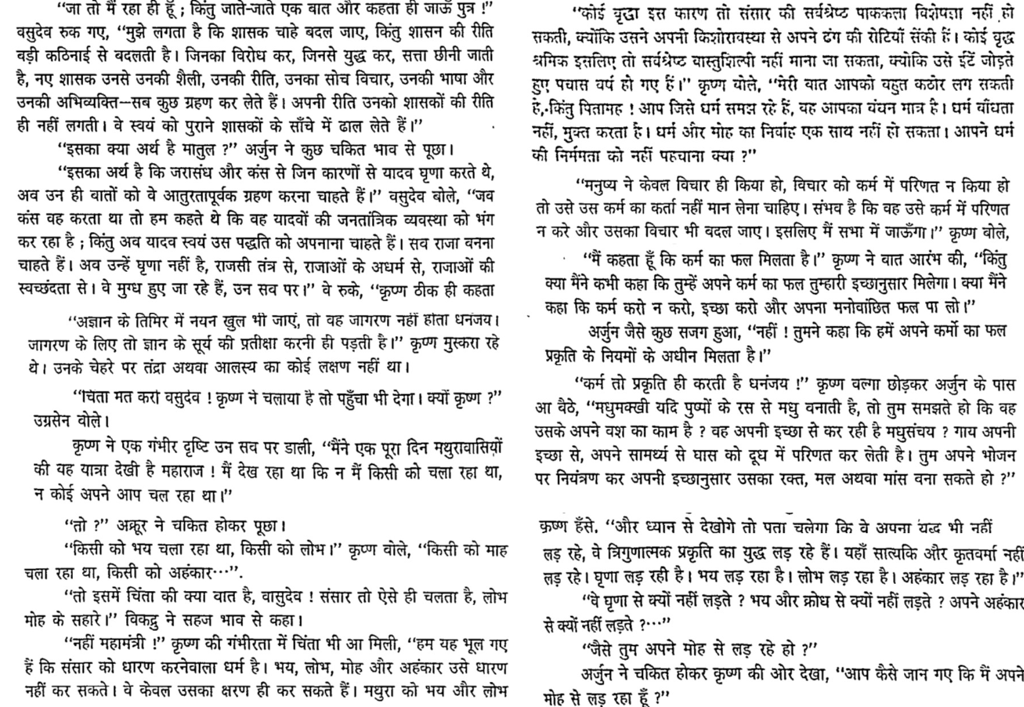
One of the most powerful aspects of Pratyaksh is the psychological and philosophical exchange between Krishna and Arjuna. The author emphasizes the inner turmoil of warriors, showing that the real battle begins within the mind before it appears on the battlefield.
Role of Krishna
Krishna is portrayed not only as a divine figure but also as a strategist, philosopher, and guide, whose decisions shape the course of events. Before the war, Krishna goes to the court of Dhritarashtra as a peace envoy. He proposes a fair settlement for the Pandavas, but Duryodhana refuses and even attempts to arrest him.
Krishna reveals his divine power and escapes, showing that arrogance blinds rulers, while truth remains invincible.
War is shown as a result of failed diplomacy, alliances, and power struggles, rather than mere destiny.
Krishna responds not with simple encouragement, but with deep reasoning: Krishna explains that the war is merely a result, not the cause. The real causes lie within the Kauravas:
• Fear – fear of losing power and status
• Greed – refusal to give even what is justly due
• Ego – Duryodhana’s pride blinds him to reason
• Hatred – long-standing jealousy toward the Pandavas
Thus, avoiding war does not eliminate injustice—it allows it to grow.
War is portrayed not as destiny, but as a consequence of Fear, Greed, Ego, and Hatred. This makes the narrative highly relevant to modern society.
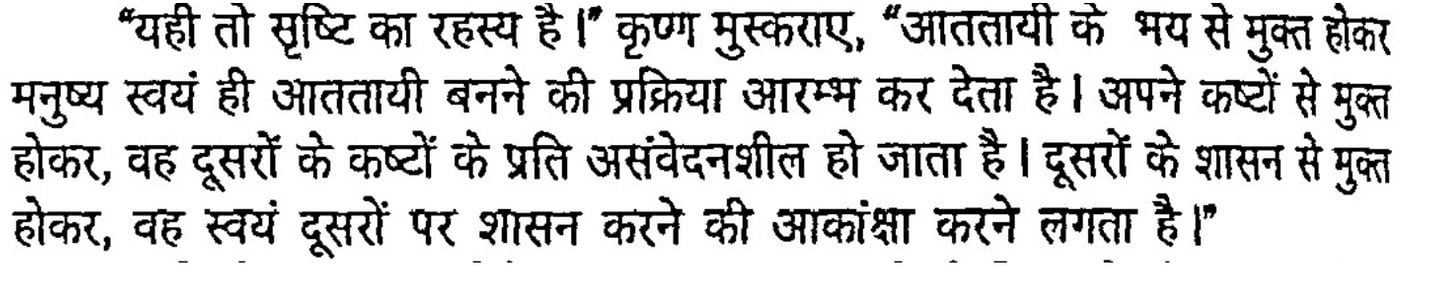
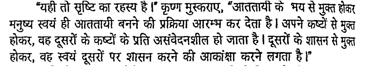
Krishna points out that Arjuna’s compassion is not entirely pure—it is mixed with attachment (moh).
• True dharma requires clarity, not emotional weakness
• Personal relationships cannot override justice
• Even revered figures like Bhishma and Drona are standing on the side of adharma
Krishna challenges Arjuna: If those you respect support injustice, should they still be followed blindly?
Kishna emphasizes the concept of dharma (righteous duty):
• Arjuna is a warrior; his duty is to fight for justice
• Avoiding war out of attachment is actually neglect of responsibility
• One must act based on what is right, not what is emotionally comfortable
Krishna distinguishes between:
• Compassion rooted in truth
• Compassion rooted in fear and attachment
He urges Arjuna to rise above confusion and act with moral clarity and courage.
Characters are not divine stereotypes but deeply conflicted individuals, making their struggles relatable.
The book stresses that neutrality or inaction in the face of injustice is itself a form of wrongdoing.
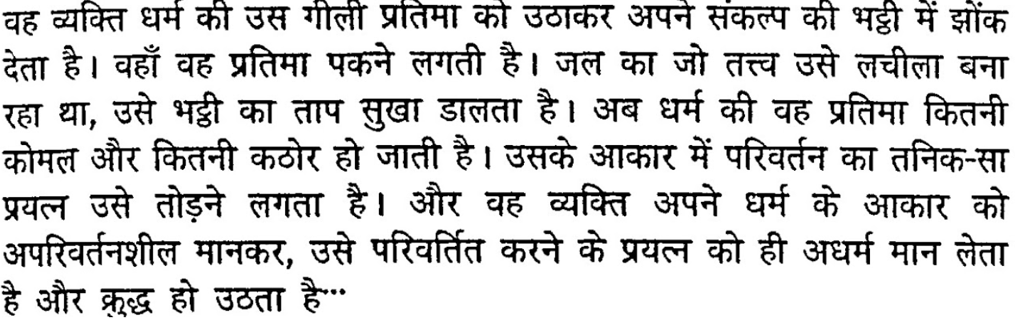
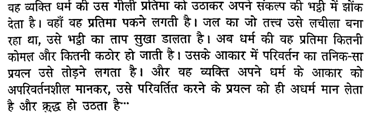
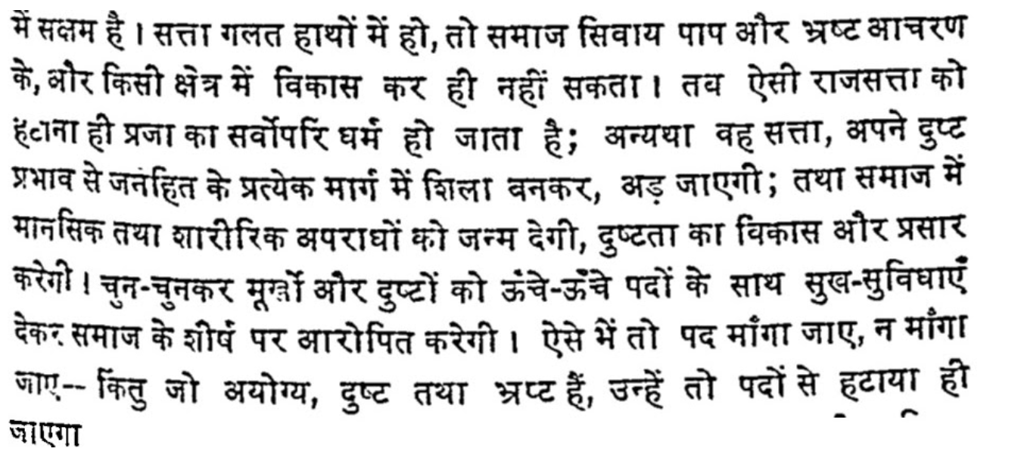
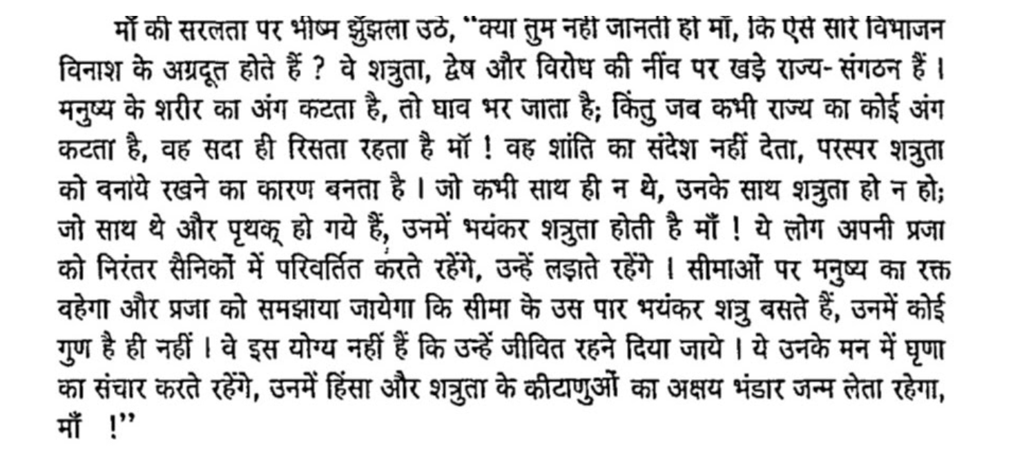
Some must read excerpts, from various chapters of the book are attached.
Now eagerly waiting to read Vol-8 of Mahasamar "Nirbandh ".