ASHTA - 8 - ( अष्ट )- A Symbol of Cosmic Order and Spiritual Completeness
While listening to the chant,
"ॐ गं गणपतये नमः। - "I bow to Lord Ganesha and seek His blessings."
सिद्धि विनायक नमो नमः। - "Repeated salutations to Siddhi Vinayak, the giver of success and fulfillment."
अष्टविनायक नमो नमः। - "Repeated salutations to Ashtavinayak, the eight revered forms of Lord Ganesha."
गणपति बाप्पा मोरया। - "O revered Father Ganpati, we praise and adore You."
"Morya" is traditionally linked to the saint Morya Gosavi, a great devotee of Lord Ganesha."
I was inquisitive about “Ashtavinayaka” the eight revered forms of Ganesha. So I dived deep into the philosophy behind the word. I came to know that there are Eight Ashtavinayak Temples in Bharat, each has its significance in Hindu Dharma.
Mayureshwar Temple (Morgaon, Maharashtra) - Ganesha is believed to have defeated the demon Sindhu while riding a peacock (mayur).
Siddhivinayak Temple (Siddhatek, Ahmednagar district, Maharashtra) - Associated with granting spiritual accomplishment (siddhi). Only Ganesha Temple with Right facing Trunk.
Ballaleshwar Temple (Pali, Raigad district, Maharashtra) - Named after Ballal, a young devotee whose devotion pleased Ganesha.
Varadvinayak Temple (Mahad, Raigad district, Maharashtra) - "Varad" means giver of boons and blessings.
Chintamani Temple (Theur, Maharashtra) - Ganesha is worshipped as the remover of worries (chinta).
Girijatmaj Temple (Lenyadri, Maharashtra) - Believed to be the place where Goddess Parvati gave birth to Ganesha.
Vighnahar Temple (Ozar, Maharashtra ) - Ganesha is worshipped as the destroyer of obstacles (vighna).
Mahaganapati Temple (Ranjangaon, Maharashtra) - Represents the powerful form Mahaganapati.
I understood that when devotees say "Ashtavinayak Namo Namah", they are offering salutations to all eight divine forms of Ganesha, each representing different blessings such as-Wisdom, Success, Protection, Removal of obstacles, Fulfillment of wishes, Peace of mind. Spiritual growth.
I was getting fascinated with the word “Ashta” , which literally means eight (8) and I am aware that there exist many words in Hindi, which have “Ashta” prefix. My research on “Ashta” lead me to so many words with “Ashta” as prefix having deep spiritual meaning. As I delved deeper, I found that In Hindu Dharma and philosophy, the number eight [Ashta (अष्ट)-8] is not just a mathematical digit, it is a sacred symbol of wholeness, cosmic order, and spiritual completion. The number eight represents the manifestation of the divine in the physical and spiritual universe.
Here are the key words prefixed with 'Ashta' across different spiritual and cosmic dimensions that I could explore - Ashta Dikpala (अष्टदिक्पाल), Ashta Prakriti (अष्ट प्रकृति), Ashta Lakshmi (अष्टलक्ष्मी), Ashta Vasus (अष्ट वसु), Ashta Siddhi (अष्ट सिद्धि), Ashtanga Yoga- (अष्टांग योग), Ashtakon (अष्टकोण), Ashtamangala- अष्टमंगल, AshtaDhatu (अष्टधातु), Ashta Nemi (अष्ट नेमि), Aṣhṭāhnika (अष्टान्हिका), Ashta Bhairava (अष्ट भैरव), Ashta Chhap (अष्टछाप), Ashta Nayika (अष्टनायिका), Ashta Matrika (अष्ट मातृका), Ashta Mahishi (अष्ट महिषी) (Ashtabharya), Ashtavakra Gita (अष्टावक्र गीता), Ashtadhyayi (अष्टाध्यायी),, Ashta Prahar (अष्ट प्रहर), Ashta Bhuja (अष्टभुजा), Ashtavaidya (अष्टवैद्य), Ashtami (अष्टमी), Ashtanga Pranam (अष्टांग प्रणाम), Eight Pointed Star (अष्टकोणीय तारा), Ashtakam (अष्टकम्), अष्टपदी (Aṣṭapadī / Ashtapadi), Ashtadal Padma (अष्टदल पद्म) and Ashta Chiranjivi (अष्टचिरंजीवी).
1. Cosmic Order and Spatial Balance (The Eight Directions - अष्टदिक्पाल)
In Hindu cosmology, the universe is stabilized and protected by the Ashta Dikpala. (अष्टदिक्पाल) means the eight guardians of the eight directions in Hindu tradition.
Ashta = eight
Dik = direction
Pala = protector or guardian
The Ashtadikpalas are divine beings who protect the universe from the eight principal directions.
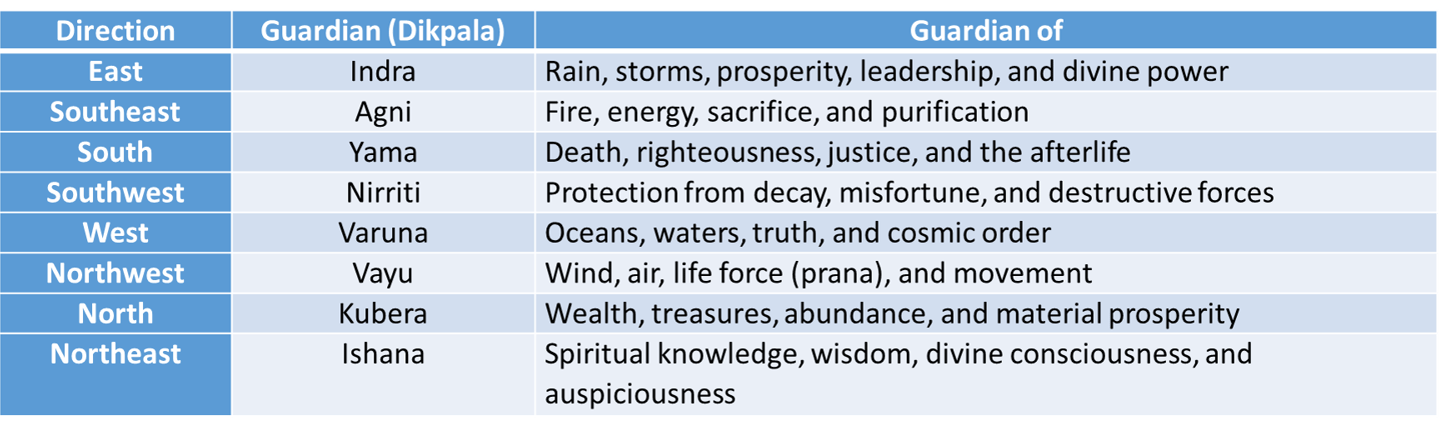
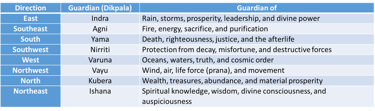
This signifies that divine protection and order encompass the entirety of space. In architecture (Vastu Shastra) and rituals, balancing these eight directions is crucial to bringing harmony to a structure or a sacred space.
2. The Blueprint of the Material World (Ashta Prakriti अष्ट प्रकृति)
In the Bhagavad Gita (Chapter 7, Verse 4), Lord Krishna explains that material nature (Prakriti) divided into eight distinct components.
Sanskrit
भूमिरापोऽनलो वायुः खं मनो बुद्धिरेव च ।
अहङ्कार इतीयं मे भिन्ना प्रकृतिरष्टधा ॥
bhūmir āpo 'nalo vāyuḥ khaṁ mano buddhir eva ca
ahaṅkāra itīyaṁ me bhinnā prakṛtir aṣṭadhā
"Earth, water, fire, air, space, mind, intellect, and ego---->these eight constitute My distinct material energy."
This Ashta Prakriti concept is fundamental to Hindu philosophy, showing that both the physical universe (the five elements) and the psychological universe (mind, intellect, and ego) emerge from the same divine source.
3. Universal Totality and Prosperity - Ashta Lakshmi (अष्टलक्ष्मी)
Hindu philosophy acknowledges that human life requires a balance of different types of well-being, not just monetary wealth. This is beautifully represented by the eight dimensions of prosperity needed for a complete life.
· Significance: Represents the eight distinct manifestations of Goddess Lakshmi, symbolizing all facets of prosperity required for human fulfillment:
- Adi Lakshmi (primordial wealth)
- Dhana Lakshmi (monetary wealth)
- Dhanya Lakshmi (agricultural abundance)
- Gaja Lakshmi (power and royalty)
- Santana Lakshmi (progeny and family)
- Veera Lakshmi (courage and valor)
- Vijaya Lakshmi (victory)
- Vidya Lakshmi (knowledge)
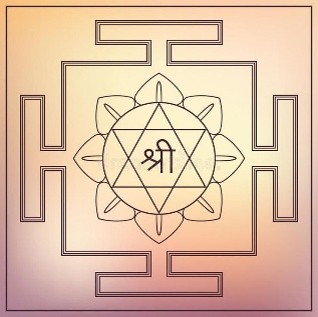
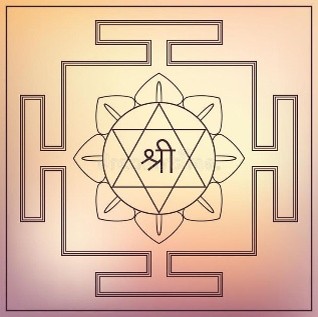
An Ashtalakshmi Yantra is a sacred geometric diagram used for meditation and worship to invoke the eight forms of Goddess Lakshmi. Goddess Lakshmi favors an abundant and generous heart. In Hindu tradition, she is described as Chanchala (ever-moving), residing where energy flows freely through ethical earning, generous giving, and continuous investment in yourself and society.
4. Divine beings associated with cosmic forces and natural phenomena - Ashta Vasus (अष्ट वसु)
The eight elemental deities who represent the cosmic energy dwelling within nature and sustaining human life. The Ashta Vasus (“Eight Vasus”) are a group of eight divine beings in Hindu tradition. The word Vasu means “dweller,” “radiant one,” or “one who abides in all things.” They are often associated with natural elements and cosmic forces. They are:
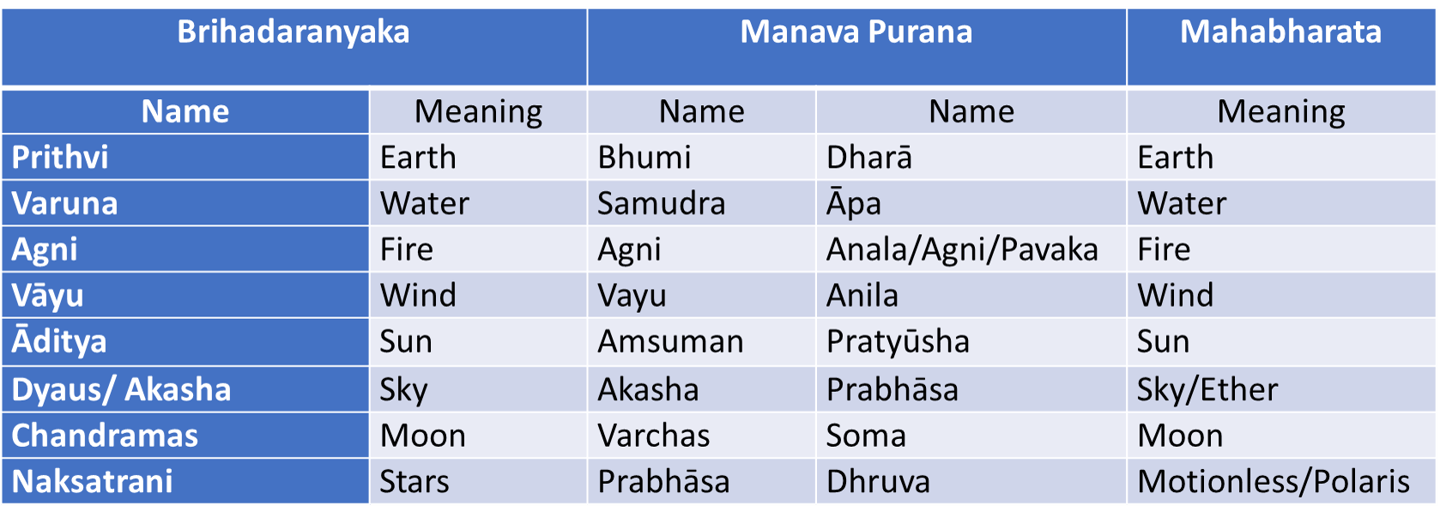
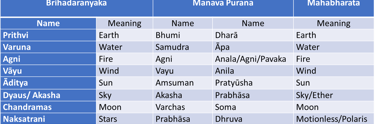
Connection with the Mahabharata
A famous story in the Mahabharata tells how the Ashta Vasus were cursed by the sage Vashistha to be born on Earth after they stole his divine cow. The river goddess Ganga agreed to become their mother and free them from the curse. After birth, she released seven of them immediately into the river, ending their earthly lives and freeing them. The eighth Vasu, usually identified as Dyu (sometimes associated with Prabhasa in certain traditions), had a greater share in the offense and therefore had to live a full human life. He was born as Bhishma, one of the central figures of the Mahabharata.
Relation to Bhagavad Gita 7.4
The eight elements listed in Bhagavad Gita (earth, water, fire, air, space, mind, intellect, and ego) are not the same as the Ashta Vasus. The Gita's list describes the eightfold division of material nature (apara prakriti), whereas the Ashta Vasus are a class of divine beings associated with cosmic forces and natural phenomena
5. The eight supernatural milestones - Ashta Siddhi (अष्ट सिद्धि):
The eight supernatural milestones a practitioner achieves upon mastering the physical and subtle body, representing total dominion over nature through yoga, tantra, and devotion to Shri Hanuman.
The eight siddhis are:
Aṇimā – Ability to become extremely small.
Mahimā – Ability to become immensely large.
Garimā – Ability to become extremely heavy.
Laghimā – Ability to become extremely light.
Prāpti – Ability to obtain or reach anything anywhere.
Prākāmya – Ability to fulfill any desire or experience anything desired.
Īśitva – Lordship or mastery over nature and creation.
Vaśitva – Power to control or influence beings and forces.
In the popular devotional hymn Hanuman Chalisa, there is a line:
"Ashta siddhi nav nidhi ke data"
("You are the giver of the eight siddhis and the nine treasures.")
This line praises Shri Hanuman as one who can bestow these spiritual powers upon devotees.
Many spiritual teachers interpret the Ashtasiddhis symbolically—as representing mastery over the mind, ego, desires, and limitations—rather than literal supernatural abilities.
6. The Path to Spiritual Evolution (Ashtanga Yoga- अष्टांग योग)
Sage Patanjali structured the journey to self-realization into eight limbs (Yama, Niyama, Asana, Pranayama, Pratyahara, Dharana, Dhyana, and Samadhi). This implies that spiritual enlightenment is a step-by-step, comprehensive process that leaves no aspect of human existence untouched.
The Sanskrit word Ashtanga means "eight limbs" (ashta = eight, anga = limb). These are ethical, mental, and spiritual practices intended to lead a person toward self-realization.
The Eight Limbs (Ashtanga)
Yama (Ethical Restraints)
Guidelines for behaviour toward others:Ahimsa (non-violence)
Satya (truthfulness)
Asteya (non-stealing)
Brahmacharya (moderation/self-control)
Aparigraha (non-possessiveness)
Niyama (Personal Observances)
Disciplines for self-development:Shaucha (purity)
Santosha (contentment)
Tapas (discipline)
Svadhyaya (self-study)
Ishvara Pranidhana (surrender to the Divine)
Asana (Posture)- Originally meant a steady, comfortable posture for meditation rather than the large variety of physical poses common in modern yoga.
Pranayama (Breath Control)
Regulation of the breath to influence and balance vital energy.Pratyahara (Withdrawal of the Senses)
Turning attention inward and reducing distraction from external stimuli.Dharana (Concentration)
Fixing the mind on a single object, thought, or point.Dhyana (Meditation)
Sustained, uninterrupted flow of attention toward the object of concentration.Samadhi (Absorption or Enlightenment)
A state of profound meditative awareness in which the distinction between observer and observed dissolves.
7. Architectural and Ritual Geometry – Ashtakon (अष्टकोण)
The number eight is highly significant in sacred geometry. The Ashtakon (octagon) is a common shape in Hindu temple architecture, acting as the transition bridge between the square base (representing the earthly realm) and the circular dome (representing the infinite, celestial realm). Ashtakon (derived from Sanskrit: Ashta meaning "eight" and Kona meaning "angle") literally translates to an octagon—a polygon with eight angles and eight sides. Beyond basic geometry, the term holds deep significance across various Indian cultural, architectural, and spiritual contexts.
a) Sacred Architecture (Vastu Shastra)
In traditional Indian architecture, an Ashtakon floor plan or pillar design is highly auspicious.
· The Eight Directions: The eight sides represent the four cardinal directions (North, South, East, West) and the four ordinal directions (Northeast, Northwest, Southeast, Southwest).
· Energy Balance: Building a temple sanctum, a stepped well (baori), or a courtyard in an octagonal shape is believed to harmonize environmental energies by drawing from all eight directional quadrants.
b) Spiritual Symbols & Yantras
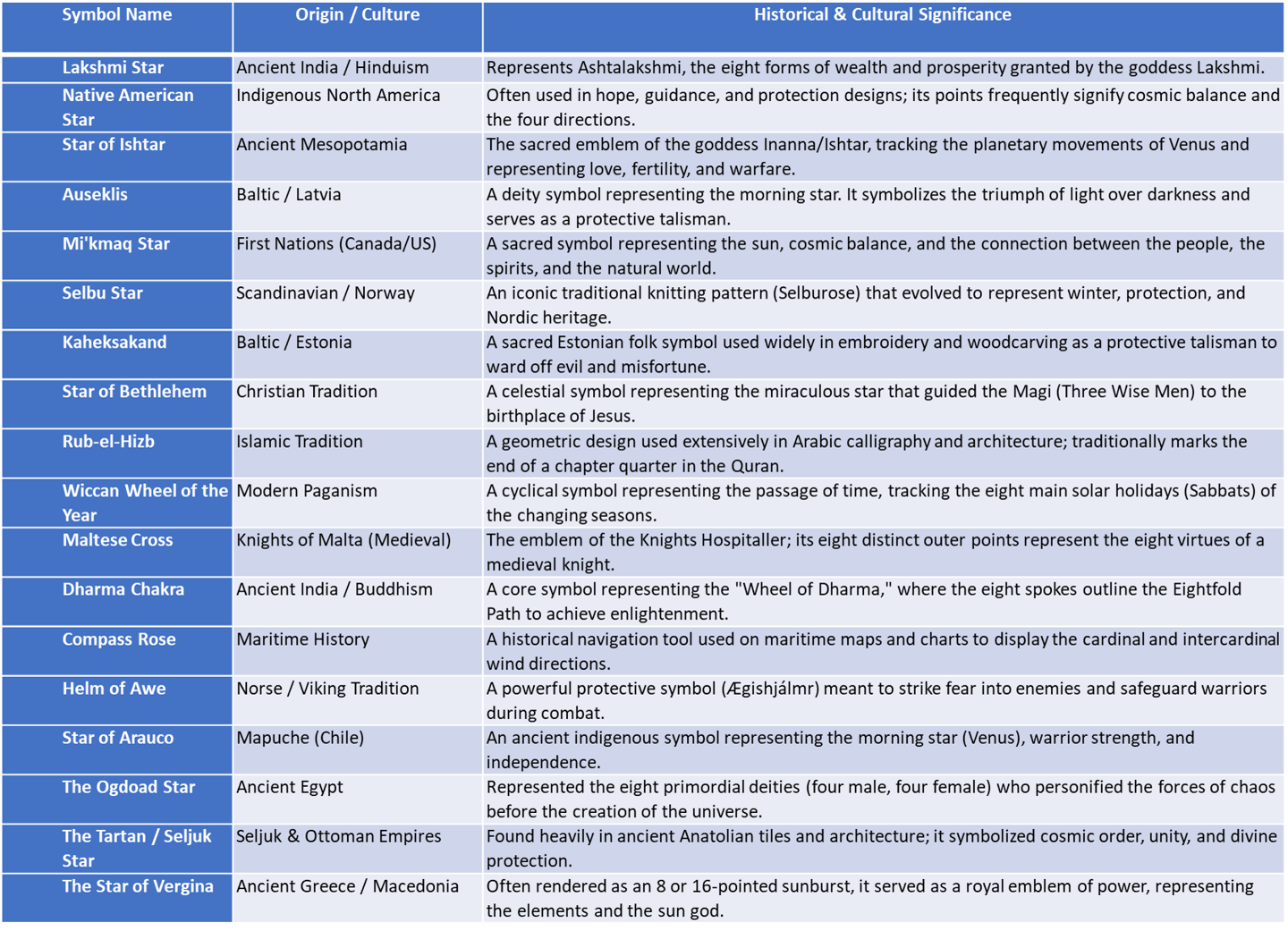
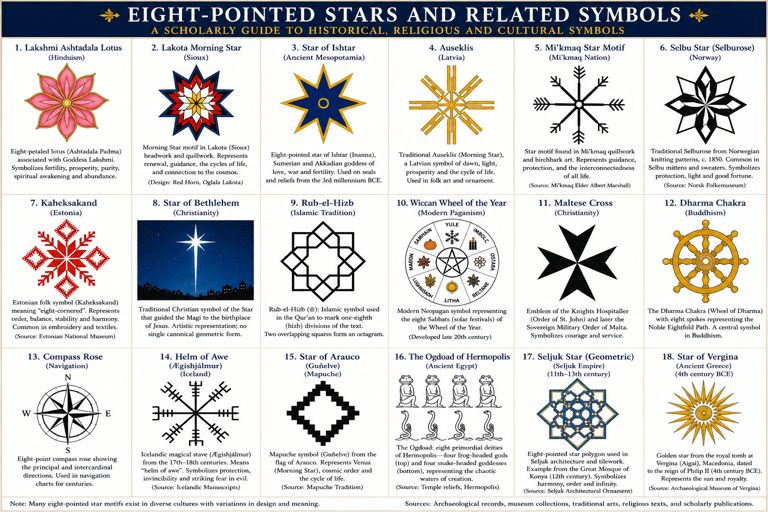
In Hinduism and Tantric traditions, the eight-pointed star (often formed by overlapping two squares at 45-degree angles) is a sacred geometric motif known as the Star of Lakshmi (Ashta Lakshmi). It represents the eight forms of wealth and prosperity granted by the goddess Lakshmi: spiritual wealth, material wealth, agriculture, royalty, knowledge, courage, progeny, and victory.
c) Historical Forts and Seals
The octagonal shape was frequently used by Indian rulers for strategic and symbolic reasons. A famous historical example is the Rajmudra (the royal seal of Chhatrapati Shivaji Maharaj), which was cast in an Ashtakon shape to signify his rule extending to all eight horizons.
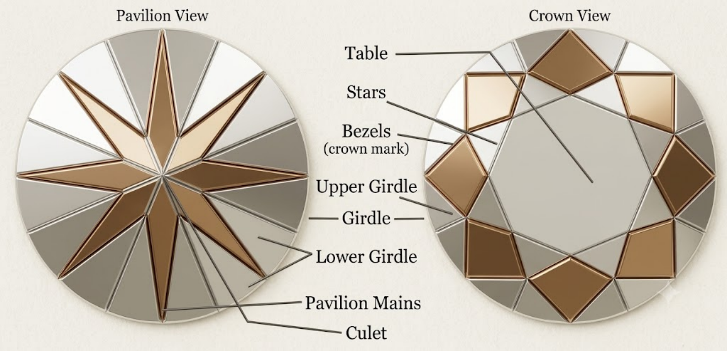
d) Eight Stars at the Crown and Girdle of Diamond
A standard round brilliant diamond features exactly 8 star facets to ensure optimal symmetry, secure the mathematical alignment of the crown, and maximize light performance. Together with other crown facets, they gather and disperse light to create fire, brilliance, and scintillation
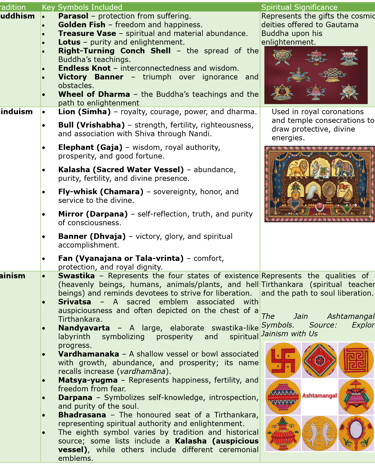
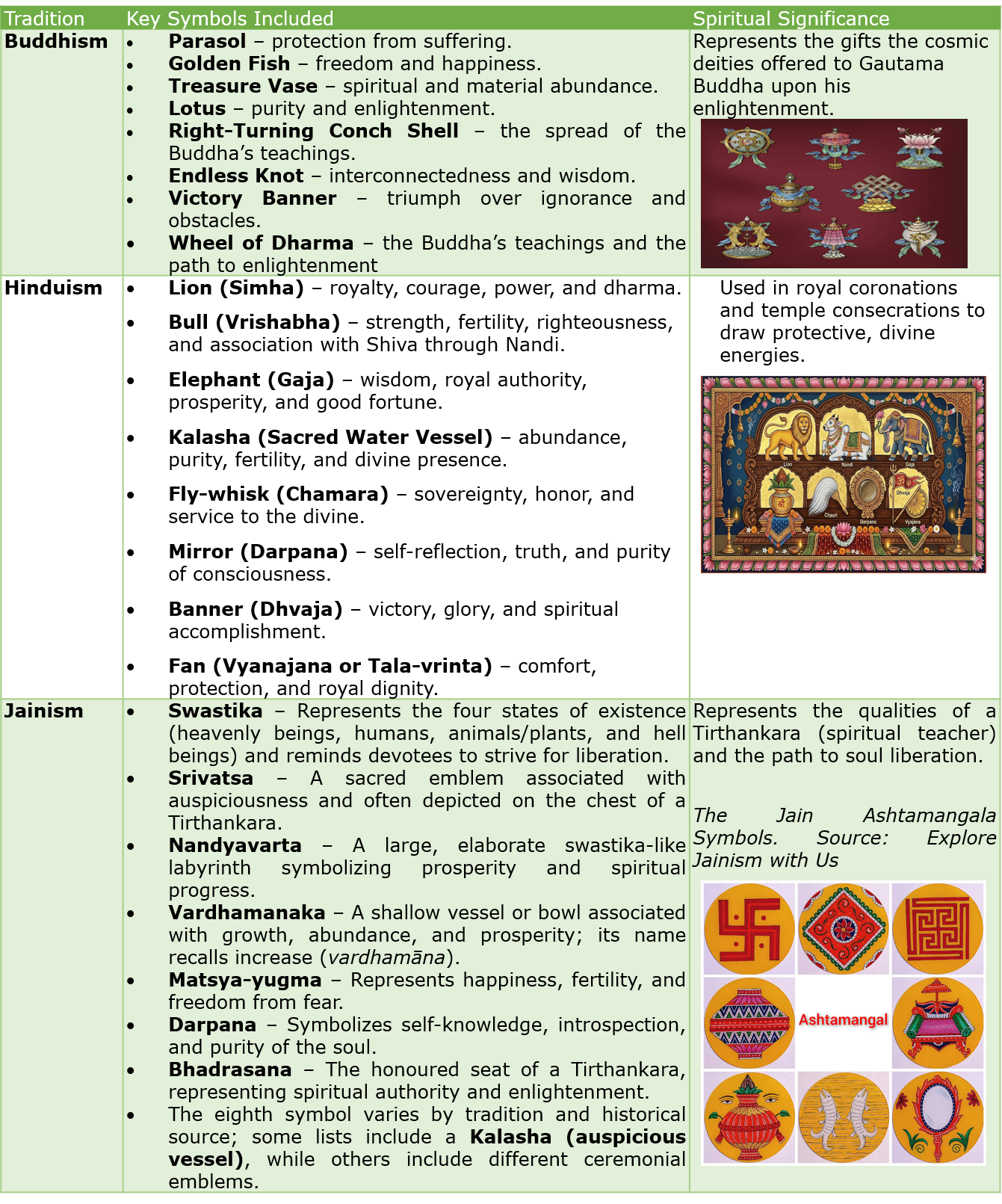
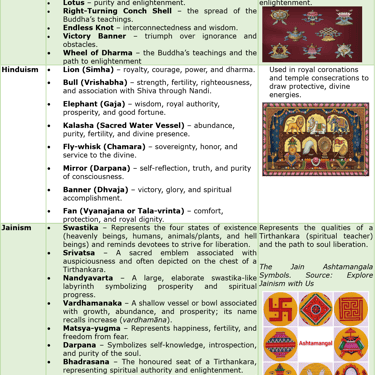
8. Positive cosmic vibrations - Ashtamangala- अष्टमंगल (eight auspicious symbols) are used in rituals to attract positive cosmic vibrations.
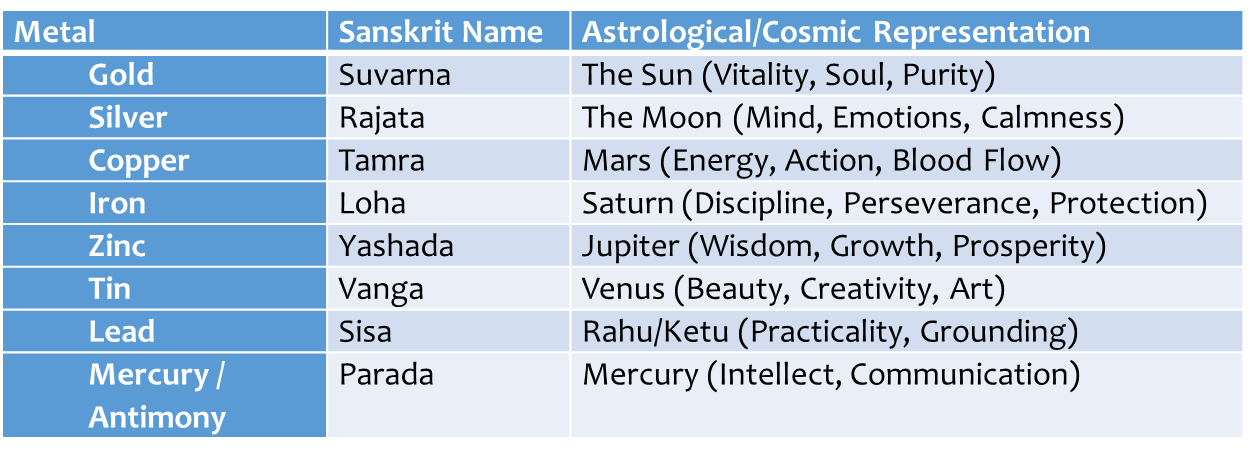
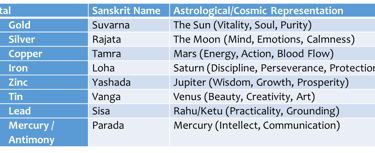
This sacred alloy of eight metals is highly revered in Hinduism for its spiritual purity and planetary alignment, making it the ideal material for casting holy idols and talismans.
According to the ancient text Shilpa Shastras (the traditional science of arts and crafts), true Ashtadhatu is a blend of eight specific metals. In Vedic philosophy, nothing is purely physical, each metal corresponds to a celestial body (the Navagraha) and acts as a physical conductor for its cosmic energy.
Spiritual Significance
In Hindu tradition, Ashtadhatu is considered highly Sattvik (virtuous, pure, and spiritually alive).
The Shield of Purity: Unlike simple metals like iron or copper on their own, the balanced amalgamation of these eight metals ensures that the alloy does not easily decay, tarnish deeply, or erode over centuries. This makes it ideal for Prana Pratishtha—the ritual that invites a deity's life force into an idol.
Energy Reservoir: During temple rituals, idols undergo continuous Abhishekam (bathing with milk, honey, and water) and chanting. Ashtadhatu acts like a battery, absorbing the acoustic vibrations of mantras and the positive spiritual energy of the environment, radiating it back to the devotees.
Astrological & Ayurvedic Benefits
When worn as a ring or a talisman (usually under the guidance of a Vedic astrologer), Ashtadhatu acts as a universal balancer.
· Planetary Equilibrium: Because it contains metals representing all major planetary energies, wearing it helps neutralize the malefic (negative) effects of weak planets in a person's horoscope while boosting the strong ones.
· Willpower & Focus: Combining the grounding power of Saturn (Iron) with the solar energy of the Sun (Gold) is believed to dramatically clear brain fog, boost confidence, and sharpen determination.
· Biophysical Balance: According to Ayurveda, touching these metals aids the flow of Prana (life force) through the body’s meridians. It is often cited as a tool to balance the three Doshas (Vata, Pitta, and Kapha).
10. Ashta Nemi (अष्ट नेमि)- made of eight fellies
Symbolism of the Wheel
In Vedic and Upanishadic symbolism, the "wheel" often represents the cycle of time or the universe. An eight-rimmed wheel specifically symbolizes:
The Eight Fold Path: In various traditions, it represents the eight components of nature or the eight stages of spiritual practice. The Eightfold Path (or Noble Eightfold Path) is one of the foundational teachings of Buddhism.
Right Understanding (or View): Seeing the world as it really is, which means deeply grasping the Four Noble Truths (that suffering exists, it has a cause, it can end, and this path is the way to end it).
Right Intention (or Resolve): Committing to self-improvement, mental purity, and acting out of love, non-violence, and compassion rather than desire or anger.
Right Speech: Speaking truthfully, kindly, and purposefully. This means abstaining from lying, harsh language, malicious gossip, and idle chatter.
Right Action: Behaving in a way that does no harm to others. It includes abstaining from taking life, stealing, and sexual misconduct.
Right Livelihood: Earning a living through a profession that does not exploit, harm, or bring suffering to other living beings (e.g., avoiding trades involving weapons, human trafficking, or poisons).
Right Effort: Actively training your mind to prevent unwholesome thoughts from arising, letting go of negative states that have already arisen, and nurturing positive, wholesome thoughts.
Right Mindfulness: Developing a sharp awareness of your body, feelings, mind, and thoughts in the present moment without judgment.
Right Concentration: Cultivating a deep, focused mental state through meditation, allowing the mind to become completely still and unified.
The "Right" Meaning: The word traditionally translated as "Right" (Sammā) doesn't just mean "correct" versus "wrong." It translates more accurately to "appropriate," "wise," or "wholesome"—actions that lead toward peace rather than more conflict
The Universe: The Shvetashvatara Upanishad uses the metaphor of a wheel with eight rims to describe the physical and metaphysical layers of existence. In Chapter 1, Verse 4 of the Shvetashvatara Upanishad, the universe and human existence are described using the metaphor of a massive, cosmic wheel (the Wheel of Brahman).
तमेकनेमिं त्रिवृतं षोडशान्तं शतार्धारं विंशतिप्रत्यराभिः ।
अष्टकैः षड्भिर्विश्वरूपैकपाशं त्रिमार्गभेदं द्विनिमित्तमोहम ॥ ४ ॥
The verse specifically mentions "six sets of eight". Rather than just one group of eight, the text layers six different octads (groups of eight) to map out both the physical (empirical) and metaphysical (mental/spiritual) layers of reality.
The six sets of eight layers are broken down as follows:
Layer- I- The Eightfold Source of Matter (Prakrtyashtaka)
This layer represents the raw components that make up the physical universe and our physical bodies. According to Samkhya philosophy (which heavily influences this Upanishad), nature is divided into eight parts:
· The 5 Gross Elements: Earth (Prithvi), Water (Apas), Fire (Agni), Air (Vayu), and Space (Akasha).
· The Cosmic Mind (Manas)
· The Intellect/Ego (Buddhi and Ahamkara)
· The Unmanifested Primordial Nature (Avyakta)
Layer – II- The Eight Bodily Substances (Dhatvastaka)
This layer represents the physical components and tissues that sustain the human body:
· Skin (Twak)
· Dermis/Internal Skin (Charma)
· Flesh/Muscle (Mamsa)
· Blood (Rakta)
· Fat (Meda)
· Bone (Asthi)
· Marrow (Majja)
· Semen/Vital Fluid (Shukra)
Layer-III- The Eight Mystical Powers (Aishvaryastaka / Siddhis)
These represent the metaphysical potentials or supernatural capacities that exist within consciousness, which a yogi can unlock:
· Anima: The power to become infinitesimally small.
· Mahima: The power to grow infinitely large.
· Garima: The power to become infinitely heavy.
· Laghima: The power to become weightless.
· Prapti: The power to instantly access or travel anywhere.
· Prakamya: The power to realize any desire.
· Isitva: Absolute lordship or power over creation.
· Vasitva: The power to control and tame all natural forces.
Layer-IV- The Eight Mental States / Dispositions (Bhavastaka)
These are the internal psychological or metaphysical states of the human mind that bind or free the soul:
· Virtue (Dharma)
· Knowledge (Jnana)
· Detachment (Vairagya)
· Spiritual Power (Aishwarya)
· ...and their exact four opposites: Vice (Adharma), Ignorance (Ajnana), Attachment (Raga), and Powerlessness (Anishwarya).
Layer-V- The Eight Cosmic Deities (Devastaka)
These represent the divine, macrocosmic forces that rule over different layers of the universe, often correlated with the directional guardians or Vedic gods:
· Brahma (The Creator)
· Prajapati (The Lord of Creatures)
· Devas (The shining celestial beings)
· Gandharvas (Celestial musicians)
· Yakshas (Nature spirits)
· Rakshas (Demonic forces)
· Pitris (The Ancestors)
· Pisachas (Ghostly entities)
Layer-VI- The Eight Primary Virtues of the Soul (Gunastaka)
The final set consists of the ethical and spiritual qualities necessary to clear the mind and stop the wheel from spinning in cycles of suffering:
· Compassion to all living beings (Daya)
· Forbearance/Patience (Kshanti)
· Freedom from jealousy (Anasuya)
· Purity of mind and body (Shaucha)
· Ease/Absence of painful striving (Anayasa)
· Auspiciousness/Goodness (Mangala)
· Generosity (Akrpanya)
· Contentment/Freedom from avarice (Aspriha)
The Metaphor's Meaning: By calling these the "six sets of eight," the Upanishad shows that a human being is a complex, spinning mechanism. We are bound by our physical tissues (Set 2) and material nature (Set 1), driven by our psychological states (Set 4), influenced by cosmic forces (Set 5), tempted by power (Set 3), but ultimately liberated through spiritual virtue (Set 6).
Most commonly, "Nemi" refers to Lord Neminatha (also known as Arihtanemi), the 22nd Tirthankara of Jainism. He is highly revered and historically associated as a cousin of the Hindu deity Krishna.
When prefixed with Ashta (which means "eight"), it generally connects to the fundamental concepts of Jain worship or the nature of a Tirthankara.
· The Ashta Pratiharya (Eight Miracles): Every Tirthankara, including Neminatha, is associated with eight divine opulence or heavenly signs when they attain omniscience (Kevala Jnana). These include the Ashok tree, the throne, the divine music, the fly-whisks, and the triple umbrella.
· The Ashta Prakari Puja (Eight-fold Worship): Lay Jains routinely perform rituals dedicated to Tirthankaras like Neminatha using eight symbolic offerings (water, sandalwood paste, rice, flowers, coconut/sweets, lamp, incense, and fruits)
11. Aṣhṭāhnika (अष्टान्हिका)
In Jainism, Aṣṭāhnika (Sanskrit: ahṣṭa = eight, ahnika = days) refers to a three annual eight-day festival period considered highly auspicious.
These are not just one festival, but three separate 8-day observances in a year, traditionally occurring in the Jain lunar calendar:
Chaitra Aṣhṭāhnika (spring)
Āṣāḍha Aṣhṭāhnika (monsoon onset)
Kārtika Aṣhṭāhnika (autumn)
What happens during Aṣṭāhnika?
During these eight-day periods, Jains intensify religious activities such as:
Worship of the Pañca-Parameṣṭhi (Arihants, Siddhas, Acharyas, Upadhyayas, Sadhus)
Special pujas and rituals in temples
Recitation of scriptures like the Tattvārtha Sūtra and devotional texts
Fasting or partial fasting (upavāsa, ekāśana)
Increased focus on meditation, self-discipline, and non-violence (ahiṃsā)
Spiritual significance
Aṣhṭāhnika is believed to be a time when:
Divine beings (devas) are especially active in honoring the Tirthankaras
Merit (puṇya) gained from worship and austerity is considered multiplied
It is an opportunity for purification of karma and spiritual upliftment
9. The Composition & Cosmic Alignment - AshtaDhatu (अष्टधातु)
12.Ashta Bhairava (अष्ट भैरव)
The Ashta Bhairav (Eight Bhairavas) are eight manifestations of Lord Bhairav, who himself is a fierce and terrifying manifestation of Lord Shiva. In Hindu iconography and Tantric traditions, the Ashta Bhairavs are considered the guardians of the eight directions (cardinal and intercardinal) and are closely associated with the Ashta Matrikas (eight mother goddesses).
Each Bhairav has a unique appearance, weapon, vehicle (vahana), and direction that he protects.
Here is the breakdown of the Ashta Bhairavs, their directions, and their traditional vehicles:
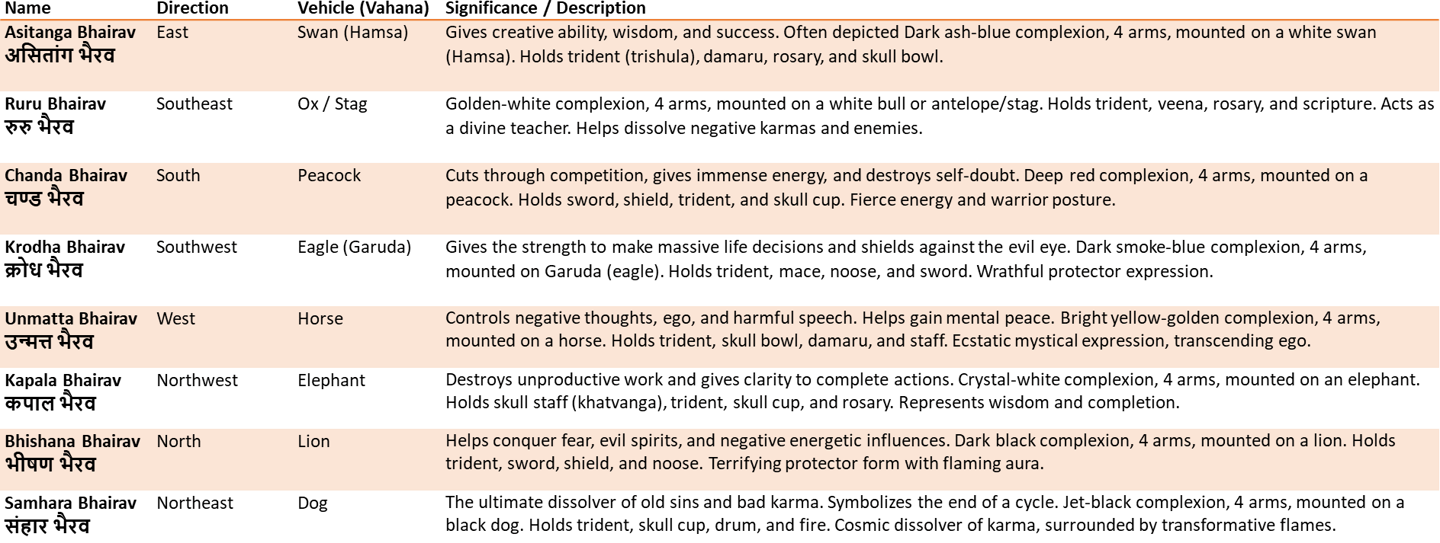

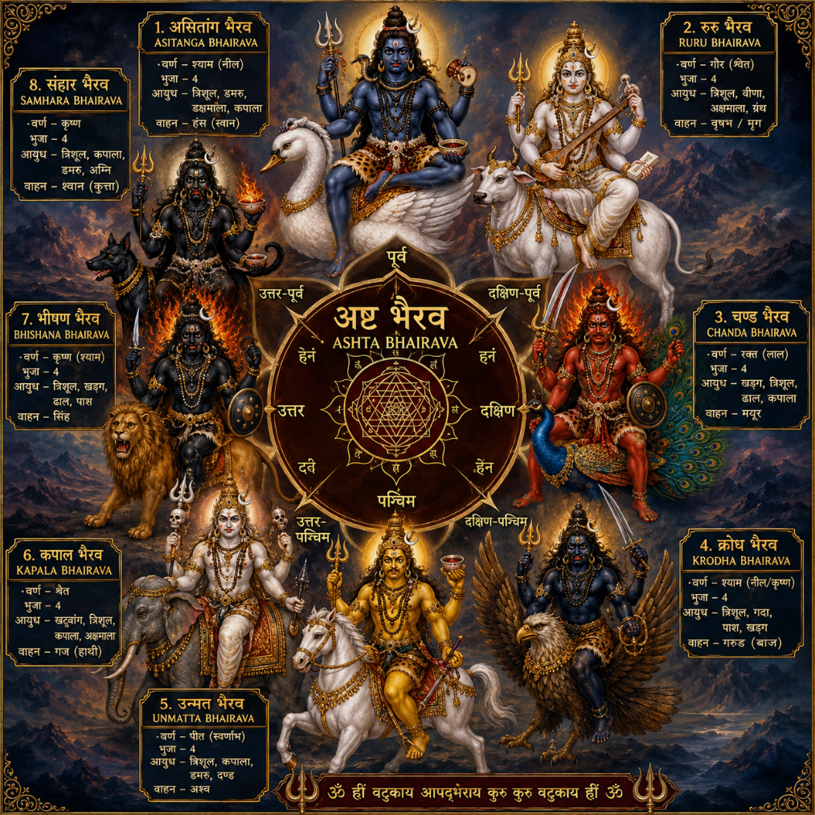
A note on accuracy: descriptions of the Ashta Bhairavas vary across texts such as the Rudrayamala Tantra, Tantrasara, and regional traditions. Skin colors, number of arms (commonly 4, 6, or 8), and weapons can differ.
Key Attributes & Worship
The Ultimate Companion: While each Bhairav has a specific primary vehicle (like an elephant or swan), Lord Bhairav as a whole is almost universally associated with a shvana (dog), which is seen guarding or walking alongside him.
The Supreme Ruler: All eight Bhairavas are ruled by Kala Bhairava, the ultimate lord of Time and the chief guardian deity of Kashi (Varanasi).
Significance in Temples: In many ancient South Indian temples (especially Shiva temples), shrines to the Ashta Bhairavs are placed in specific directions to safeguard the temple premises from negative energies.
13. Ashta Chhap (अष्टछाप)
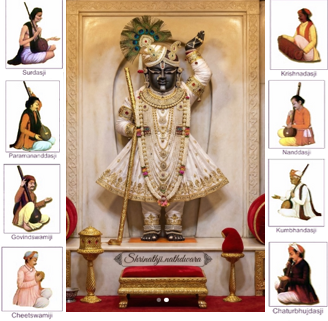
Ashta Chhap (literally meaning "Eight Seals" or "Eight Stamps") refers to a group of eight 16th-century Hindu poet-saints who were prominent figures in the Bhakti Movement, specifically within the Pushtimarg tradition of Vaishnavism founded by Vallabhacharya. These poets are celebrated for their devotional compositions (padas) dedicated to Lord Krishna, particularly in his child form as Shri Nathji in Govardhan, Braj (near Mathura)
The group was formalised by Vitthalnath, the son of Vallabhacharya, around 1565 CE. He selected four disciples of his father and four of his own to establish an elite group of musicians and poets who would handle the musical and devotional services (Seva) at the Shrinathji temple.
The eight poets are divided based on who initiated them:
Disciples of Vallabhacharya
1. Surdas: The most famous of the group, a blind poet whose monumental work Sur Sagar is a masterpiece of Hindi literature.
2. Kumbhandas: Known for his strict adherence to devotion over worldly riches.
3. Paramanandadas: Famous for deeply emotional poems describing Krishna's childhood.
4. Krishnadas: An expert administrator who also composed beautiful devotional songs.
Disciples of Vitthalnath
5. Govindswami: A great musician who lived near Radha Kund.
6. Chhitswami: A former priest from Mathura who became a devout follower.
7. Chaturbhujdas: The son of Kumbhandas, who carried on his father's poetic legacy.
8. Nandadas: Culturally second only to Surdas, known for his refined language, lyrical depth, and scholarly works like Rasa Panchadhyayi.
Literary and Musical Impact
· Language: They predominantly composed their poetry in Braj Bhasha, a dialect of Hindi. Their work was instrumental in elevating Braj Bhasha into a major literary language of Northern India.
· Music: Their compositions are deeply tied to Hindustani classical music. They developed specific ragas suited for different times of the day and different seasons, creating the foundation for Haveli Sangeet (temple music of the Pushtimarg tradition).
· Themes: The central theme is Vatsalya Rasa (parental love for child Krishna) and Madhurya Rasa (romantic/devotional love of the Gopis for Krishna).
Today, their compositions remain an integral part of Vaishnava temple rituals and the classical music heritage of India.
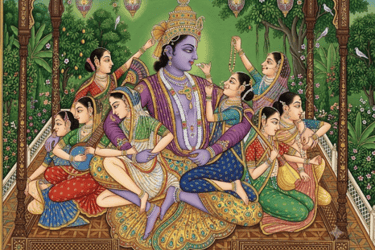
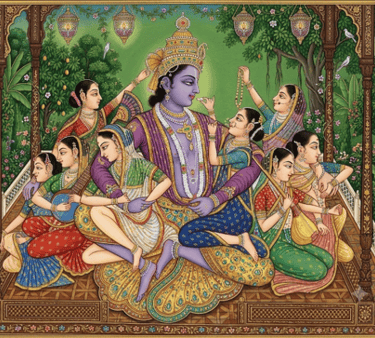
14. Ashta Nayika (अष्टनायिका)
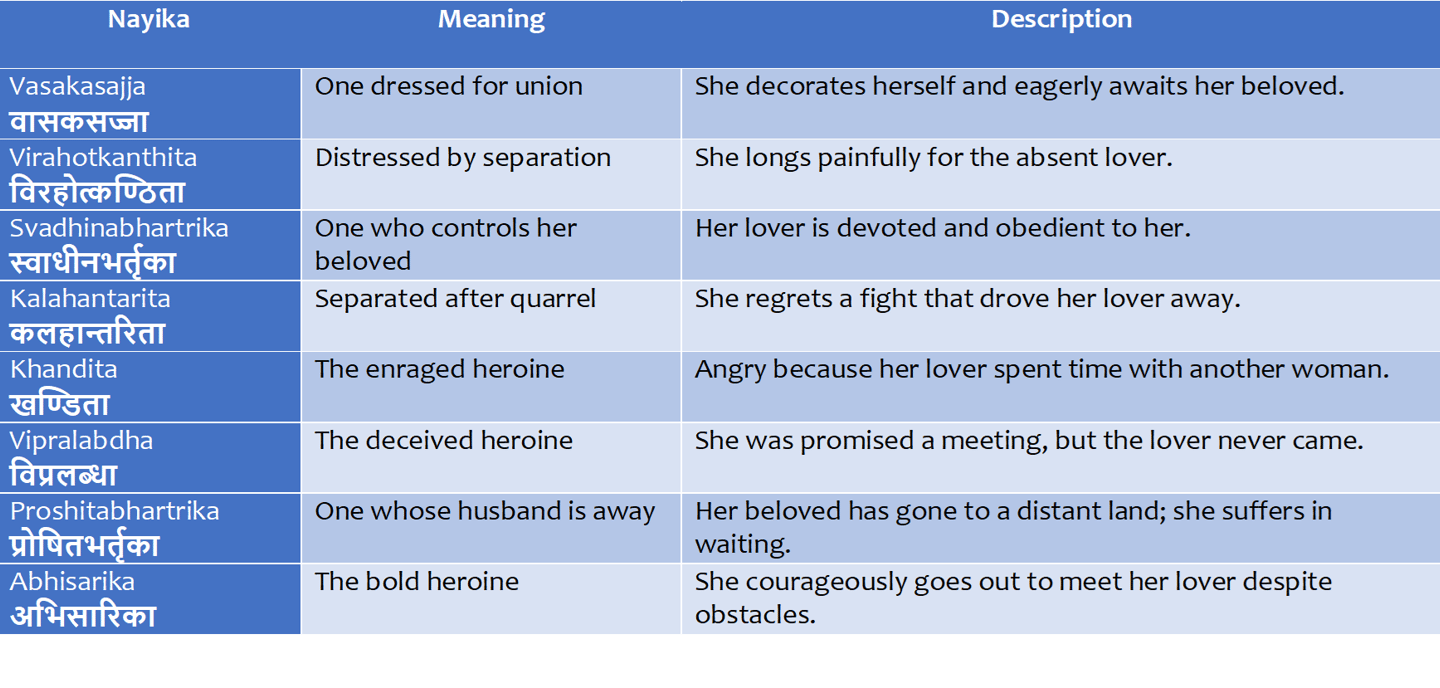
The Ashta Nayika (“Eight Heroines”) are eight archetypal states of a heroine in classical Indian aesthetics, especially described in the Nāṭyaśāstra and later elaborated in Sanskrit literature, miniature painting, dance, and music traditions like Bharatanatyam, Kathak, Odissi, and Hindustani music.
They represent different emotional conditions of a woman in relation to her lover (nāyaka), often associated with Śṛṅgāra Rasa (the aesthetic mood of love).
Importance in Indian Arts
The Ashta Nayika theme appears prominently in:
Classical dance forms such as Bharatanatyam, Kathak, and Odissi
Sanskrit poetry and drama
Rajput and Pahari miniature paintings
Devotional interpretations where the soul longs for the divine (e.g., Radha-Krishna traditions)
In Art and Literature
A famous visual tradition is the depiction of the Ashta Nayikas in Rajput miniature paintings, especially around Radha and Krishna theme.
15. Ashta Matrika (अष्ट मातृका)
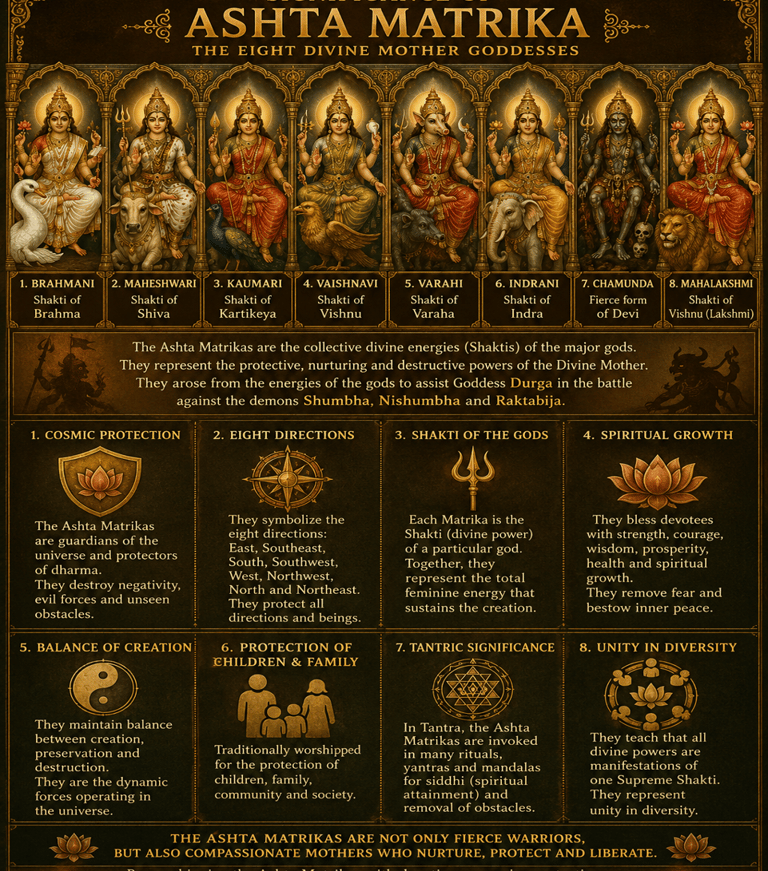
The Ashta Matrikas (Sanskrit: Aṣṭa Mātṛkāḥ, "Eight Mothers") are a group of powerful mother goddesses in Hinduism, particularly revered in Shakta, Shaiva, and Tantric traditions. They are considered manifestations of the divine feminine power (Shakti) of major male deities and are often depicted as a collective force that protects the cosmos and destroys evil.
The Eight Matrikas
Brahmani – Shakti of Brahma
Maheshwari – Shakti of Shiva (Maheshvara)
Kaumari – Shakti of Kartikeya (Skanda)
Vaishnavi – Shakti of Vishnu
Varahi – Shakti of Varaha (Vishnu's boar incarnation)
Indrani – Shakti of Indra
Chamunda – Fierce form of Devi, slayer of demons
Mahalakshmi (or sometimes Narasimhi, depending on the tradition)
The Matrikas are described in texts such as the:
Devi Mahatmya
Matsya Purana
Varaha Purana
Various Tantric scriptures
According to the legends, they emerged from the energies of the gods to assist in defeating powerful demons such as Shumbha, Nishumbha, and Raktabija
The Ashta Matrikas symbolize:
Cosmic feminine energy (Shakti)
Protection of devotees
Destruction of negative forces
The eight directions of space
The various powers operating within the universe and the human body
16. Ashta Mahishi (अष्ट महिषी) (Ashtabharya)
They are the eight primary queen consorts of the Hindu deity Lord Krishna, the king of Dvaraka, as detailed in sacred texts like the Bhagadata Purana and the Mahabharata. They are also commonly referred to as the Ashtabharya (Bharya meaning wife).
The Eight Principal Queens
According to tradition, each of these eight queens represents a distinct aspect of divine energy (Shakti) and different forms of the goddess Lakshmi.
Rukmini: The Chief Queen (Patrani). She was the princess of Vidarbha and is revered as the direct avatar of Sridevi, the goddess of prosperity and devotion.
Satyabhama: The second or third queen, known for her strong-willed, courageous, and proud nature. She was the daughter of King Satrajit and is considered an incarnation of Bhudevi (the Earth goddess).
Jambavati: The daughter of the bear-king Jambavan (from the epic Ramayana). She represents ultimate loyalty and is considered an aspect of Niladevi.
Kalindi: The personification and goddess of the Yamuna River. She represents purity, austerity, and deep spiritual devotion.
Mitravinda: The princess of the Avanti kingdom. She is celebrated for her determination, righteousness, and love.
Nagnajiti (also called Satya): The princess of the Kosala kingdom. She represents grace, truthfulness, and valor.
Bhadra: The princess of the Kekeha kingdom and Krishna's cousin. She embodies family harmony and peaceful companionship.
Lakshmana (or Lakshana): The highly skilled princess of the Madra kingdom. She represents inner radiance, focus, and strength.
Some theological interpretations regard the Ashtabharya as manifestations of the divine feminine energy (Shakti) accompanying Vishnu's incarnation as Krishna. Together they illustrate the many ways divine grace operates in the world. For devotees, the Ashtabharya are not merely historical or mythological figures. They symbolize different paths by which the individual soul (jiva) approaches God through love, surrender, service, courage, faith, discipline, wisdom and devotion. Their stories illustrate that sincere devotion can take many forms, yet all ultimately lead toward union with the Divine.
17. Ashtavakra Gita (अष्टावक्र गीता)
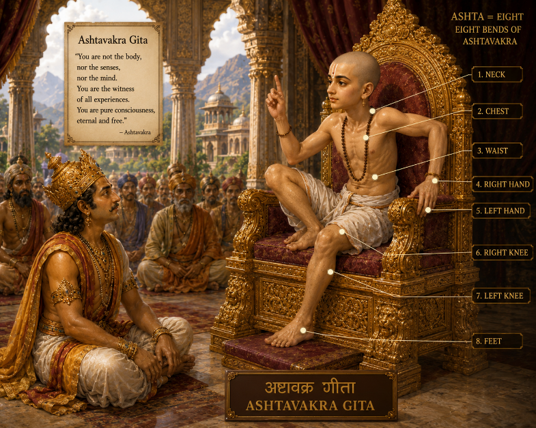
Ashtavakra is a revered sage in the Hindu tradition, best known as the teacher in the Ashtavakra Gita. According to traditional accounts, while still in his mother's womb, Ashtavakra heard his father reciting the Vedas and corrected a mistake. His father became angry and cursed him, causing his body to become bent in eight places.
The name Ashtavakra comes from Sanskrit:
Ashta (अष्ट) = eight
Vakra (वक्र) = bent, crooked, curved
Thus, Ashtavakra means "the one bent in eight places."
Significance of "Ashtavakra"
The physical story carries a deeper symbolic message:
Truth and wisdom are independent of physical appearance.
The body may be imperfect, but the Self (Atman) is perfect.
Society often judges by external form, whereas spiritual insight concerns inner reality.
A famous story tells how Ashtavakra entered King Janaka's court and was laughed at because of his appearance. He laughed back, saying the court was full of "leather merchants" because they judged him only by his skin rather than his wisdom. King Janaka recognized his greatness and became his student.
Overview of the Ashtavakra Gita
The Ashtavakra Gita is a dialogue between Ashtavakra and King Janaka. It contains 20 chapters and is one of the purest expressions of Advaita Vedanta (non-duality).
Its central teaching is that your true nature is pure awareness. You are already free. Bondage exists only because of mistaken identification with body and mind.
Chapter-by-Chapter Summary
Chapter 1: Self-Realization
Janaka asks how liberation can be attained.
Ashtavakra immediately points to the essence:
You are not the body.
You are not the mind.
You are the witness of all experience.
Freedom comes through recognizing this directly.
This chapter contains the foundational teaching of the entire text.
Chapter 2: The Joy of Self-Knowledge
Janaka quickly grasps the teaching and speaks from the perspective of realization.
The Self is infinite.
The world appears within consciousness.
Nothing can add to or subtract from one's true nature.
The tone becomes celebratory and expansive.
Chapter 3: The Test of Knowledge
Ashtavakra explains how genuine realization expresses itself.
Characteristics of the wise:
Free from craving.
Free from fear.
Unattached to praise or blame.
Inwardly peaceful.
Knowledge is measured by freedom, not by intellectual understanding.
Chapter 4: Glorification of Knowledge
The realized person:
Remains untouched by circumstances.
Acts naturally without ego.
Experiences profound inner freedom.
Knowledge is shown to be superior to ritual or external achievement.
Chapter 5: Dissolution of Ego
The ego is presented as the root illusion.
Ashtavakra teaches:
"I am the doer" is bondage.
The Self merely witnesses.
Let actions occur naturally.
Freedom arises when personal ownership dissolves.
Chapter 6: Higher Knowledge
The Self is described as:
Infinite
Unchanging
Pure awareness
The chapter repeatedly contrasts changing appearances with the changeless witness.
Chapter 7: The Nature of Bondage and Liberation
A famous teaching:
Bondage is desire.
Liberation is freedom from desire.
The emphasis is psychological rather than external.
Chapter 8: Freedom from Mental Activity
Ashtavakra encourages complete inner relaxation.
Key point:
Constant mental effort perpetuates struggle.
The Self is already at rest.
One simply abides as awareness.
Chapter 9: Detachment
The wise person understands:
All experiences come and go.
Nothing needs to be possessed.
Happiness is not dependent on circumstances.
Detachment is portrayed as natural understanding rather than suppression.
Chapter 10: Stillness
This chapter deepens the theme of inner peace.
The sage:
Neither seeks nor rejects.
Remains centered amidst change.
Experiences effortless serenity.
Chapter 11: Wisdom
The enlightened person:
Has no inner conflict.
Sees unity everywhere.
Is beyond psychological suffering.
Wisdom is presented as simplicity itself.
Chapter 12: Abiding in the Self
The realized being:
Lives in the world.
Performs ordinary actions.
Remains inwardly free.
External life may continue unchanged, but inner identification is gone.
Chapter 13: Happiness
True happiness:
Is not acquired.
Is not created by circumstances.
Is the natural radiance of the Self.
Seeking ends when one's true nature is recognized.
Chapter 14: Peace
Peace is shown as the natural condition of consciousness.
Disturbance belongs to the mind.
The Self itself is always untouched.
Chapter 15: Knowledge of the Self
A concise restatement of the core teaching:
The Self is pure awareness.
The world is appearance.
Liberation is recognizing what already is.
Chapter 16: Special Instruction
Ashtavakra becomes even more radical.
He emphasizes:
No practices are ultimately necessary.
No attainment is required.
The Self is already complete.
This chapter often surprises readers accustomed to gradual spiritual paths.
Chapter 17: The True Knower
The liberated person:
Is spontaneous.
Has no sense of personal accomplishment.
Does not think "I am enlightened."
Naturalness becomes the hallmark of realization.
Chapter 18: Peace of the Liberated
This is the longest and most famous chapter.
Major themes:
Absolute freedom.
Complete non-attachment.
The end of seeking.
Effortless awareness.
Many readers consider it the philosophical climax of the text.
Chapter 19: Living Freedom
The sage continues to function in daily life while remaining inwardly free.
The world appears, but no longer creates bondage.
Action occurs without ego-centered motivation.
Chapter 20: Liberation
The final chapter concludes:
Nothing was ever truly binding.
The Self was always free.
Enlightenment is recognition, not transformation.
The text ends in profound simplicity and silence. The Essence of the Entire Ashtavakra Gita. If the entire work were reduced to a few sentences, it would be:
You are not the body.
You are not the mind.
You are pure awareness in which all experiences arise and pass away.
Realize this, and you discover that freedom is not something to be achieved—it is your nature.
This radical immediacy is what makes the Ashtavakra Gita one of the most influential texts in the Advaita tradition, alongside works associated with Adi Shankaracharya.
18. Ashtadhyayi (अष्टाध्यायी)
Aṣhṭa (अष्ट) = eight
Adhyāya (अध्याय) = chapter, lesson, or section
Aṣhṭādhyāyī = "having eight chapters"
The Ashtadhyayi (अष्टाध्यायी, "Eight Chapters") is the foundational grammar of Sanskrit composed by the ancient Indian grammarian Pāṇini.
Key Facts
Author: Pāṇini
Date: Approximately 5th–4th century BCE (scholarly estimates vary).
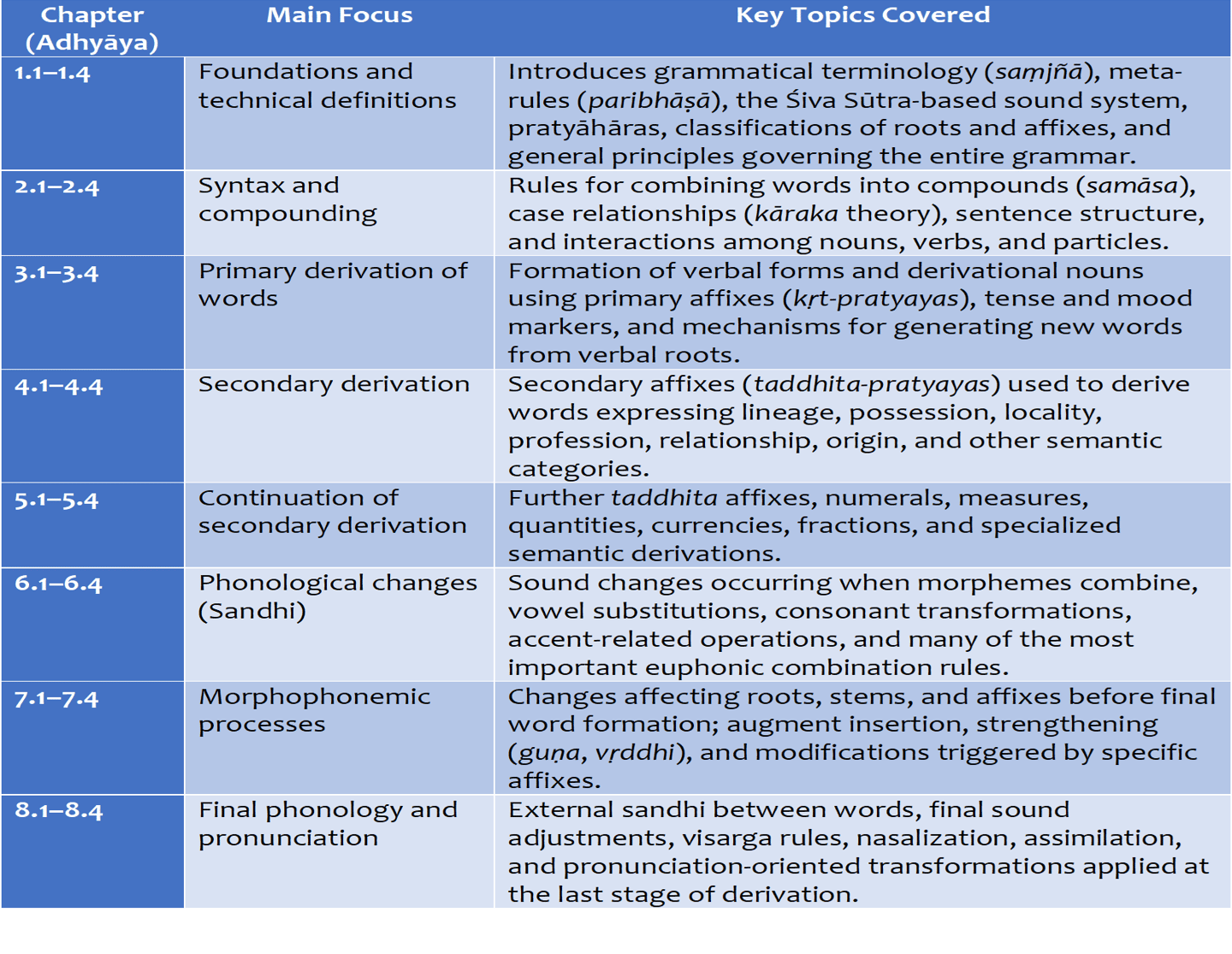
Structure: 8 chapters (adhyāyas), each divided into 4 sections (pādas).
Content: About 4,000 concise grammatical rules (sūtras).
Purpose: To describe and generate correct Sanskrit forms with remarkable precision.
Why Eight Chapters?
There is no explicit statement by Pāṇini explaining why he chose exactly eight chapters. Scholars generally view the division as a practical and pedagogical organization rather than a symbolic one.
Each chapter is further divided into four pādas (quarters), giving a total of 32 sections. This subdivision made the text easier to memorize and teach in the oral tradition.
Significance of the Eight-Chapter Structure
The eight-chapter arrangement helps Pāṇini's grammar operate like a rule engine:
Definitions come first — technical terms and conventions are established.
Word formation rules follow — roots receive affixes to create stems and words.
Sound-change rules come later — phonological transformations are applied after forms have been generated.
Final adjustments occur last — external sandhi and pronunciation rules complete the derivation.
This sequencing is crucial because later rules often depend on forms produced by earlier rules.
Is There a Deeper Symbolic Meaning?
Traditional commentaries generally focus on the grammatical function of the eight chapters rather than attributing mystical significance to the number eight. While Indian literature often treats eight as an auspicious number (e.g., eight directions, eight limbs of yoga, eight forms of wealth), there is no widely accepted traditional explanation that Pāṇini chose eight chapters for symbolic reasons.
Why the Ashtadhyayi Is So Significant
The Ashtadhyayi is remarkable because it:
Provides a complete and highly precise description of Sanskrit.
Uses concise rules (sūtras) to generate potentially unlimited correct expressions.
Employs meta-rules, technical markers, and rule-ordering principles.
Anticipates ideas found in modern formal linguistics and rule-based systems.
Preserved and standardized Sanskrit for more than two millennia.
Many historians of linguistics regard it as one of humanity's earliest and most sophisticated formal systems for describing language. Rather than merely listing correct forms, Pāṇini created a generative system that explains how those forms are produced.
19. Ashta Prahar (अष्ट प्रहर)
The Meaning of the Words
· Ashta: Means "Eight".
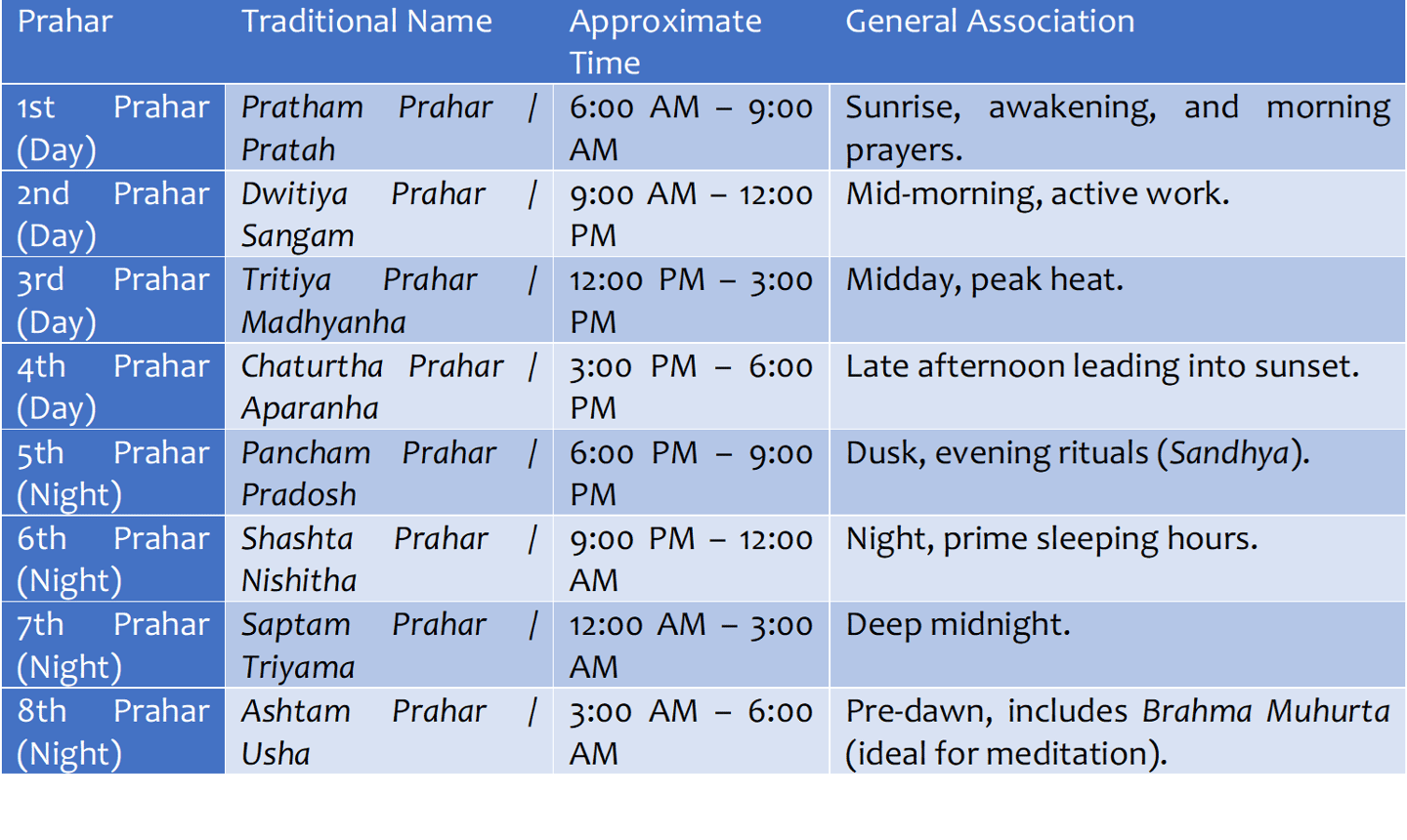
· Prahar (or Prahara): Is a traditional Indian unit of time. One prahar is roughly equal to three hours.
Therefore, Ashta Prahar refers to the 8 periods of a 24-hour day (4 periods of day and 4 periods of night).
The Traditional Time Breakdown
The day is traditionally split starting from sunrise. While the exact duration of a prahar can stretch or shrink slightly depending on the season (length of day vs. night), they generally follow this 3-hour schedule:
Cultural and Musical Significance
· Hindustani Classical Music: The Ashta Prahar framework is incredibly vital to Indian classical music. Almost every Raga (melodic framework) is assigned to a specific prahar of the day or night. It is believed that performing a Raga during its designated Prahar maximizes its emotional and spiritual impact.
· Religious Rituals: In many Hindu traditions (like Vaishnavism), Ashta Prahar Puja or Ashta Prahar Kirtan is a 24-hour non-stop devotional singing or worship cycle, where prayers change to match the mood and energy of each of the eight time blocks.
A term referring to the eight periods (prahars) of a 24-hour day, often used in classical music and temple rituals to denote specific times for ragas or prayers.
20. Ashta Bhuja (अष्टभुजा)
Ashta Bhuja (or Ashtabhuja) is a Sanskrit term that translates literally to "Eight Arms" (from Ashta = eight, and Bhuja = arms).
In Hindu iconography and mythology, it primarily refers to deities depicted with eight arms, symbolizing omnipotence, immense power, and the ability to protect devotees from all directions simultaneously.
While several deities can be depicted with eight arms, the term is most famously associated with:
· Maa Durga (Mahishasuramardini): This is the most common association. When Goddess Durga is ready for battle, she is frequently depicted as Ashtabhuja Durga, riding a lion and holding eight distinct weapons (such as a trident, discus, sword, bow, and arrow) gifted to her by the gods to defeat the buffalo demon Mahishasura.
· Lord Vishnu / Krishna: In certain manifestations or regional traditions, Vishnu is worshipped in an eight-armed form. For example, during the Vishwaroopam (universal form) or in specific local legends, he wields eight cosmic symbols/weapons.
· Ashtabhuja Ganesha: A rarer, powerful form of Lord Ganesha depicted with eight arms holding various symbolic items.
Famous Historical & Religious Sites
· Ashtabhuja Temple (Vindhyachal, Uttar Pradesh): Located on a hill near Mirzapur, this famous temple is dedicated to Goddess Ashtabhuja (believed to be Saraswati or the sister of Lord Krishna who escaped from Kansa's hands). It forms a part of the holy Vindhyachal Triloka Parikrama alongside Vindhyavasini and Kali Khoh.
Ashtabujam Temple (Kanchipuram, Tamil Nadu): Known as the Sri Sri Adhikesava Perumal Temple, this is a famous Divya Desam temple where Lord Vishnu is worshipped in his eight-armed (Ashtabhuja) form.
21. Ashtavaidya (अष्टवैद्य)
· Literal Meaning: "Eight physicians" (Vaidya = physician).
· Significance: Historically referred to traditional families of Ayurveda physicians in Kerala, India, who mastered all eight core branches of Ayurvedic medicine (Ashtanga Chikitsa), which span from general medicine and pediatrics to surgery and toxicology (Menon; Mandal).
While modern practitioners often specialize in just one area, a traditional Ashtavaidya is fully trained to diagnose and treat conditions across all eight limbs of classical Ayurveda:
· Kaya Chikitsa: General medicine (internal medicine and digestive disorders)
· Bala Chikitsa: Pediatrics (including obstetrics and gynecology)
· Graha Chikitsa: Psychiatry and psychological disorders
· Urdhvanga Chikitsa: Diseases of the head, eyes, ears, nose, throat, and teeth (ENT/Ophthalmology)
· Shalya Chikitsa: Surgery and treatment for external injuries
· Damshtra Chikitsa (Visha): Toxicology (treatment for venomous bites and poisoning)
· Jara Chikitsa (Rasayana): Geriatrics, rejuvenation, and anti-aging therapies
· Vrisha Chikitsa (Vajeekarana): Aphrodisiacs and fertility treatments
According to historical lore, the tradition traces back to Vagbhata, the legendary 6th-century scholar and author of the Ashtanga Hridayam (the foundational textbook of Kerala Ayurveda).
Legend says that Vagbhata traveled to Kerala, where he found an abundance of medicinal herbs and a receptive culture. He took eighteen elite Brahmin (Namboothiri) families as disciples, teaching them the entirety of his medical knowledge. These families became the hereditary custodians of the system, passing down secret formulations, diagnostic techniques, and palm-leaf manuscripts from generation to generation through a rigorous Gurukulam (residential apprenticeship) system that could take up to 20 years.
Over the centuries, many of the original eighteen families became extinct or merged. Today, only eight traditional Ashtavaidya families are formally recognized, and only a few actively continue to practice clinical Ayurveda. The prominent surviving lineages include:
· Thrissur Thaikkattu Mooss (Founders of famous institutions like SNA Oushadhasala)
· Elayidath Thaikkattu Mooss
· Chirattamon Mooss
· Pulamanthol Mooss
· Alathiyoor Nambi, Kuttancherry Mooss, Vayaskara Mooss, and Velluttu Mooss (historically significant, though less active in modern clinical practice).
· The Power of Ashtanga Hridayam: While Northern Indian Ayurveda relies heavily on texts like the Charaka Samhita and Sushruta Samhita, the Kerala tradition is heavily centered around the Ashtanga Hridayam, which perfectly synthesizes medicine and surgery.
· Integration with Folk Medicine: The Ashtavaidyas uniquely blended highly sophisticated Sanskrit textual knowledge with local, tribal, and folk healing practices of Kerala, which led to the creation of famous therapies like Panchakarma, Pizhichil (oil pouring), and Navarakizhi (rice bolus massage).
· Preservation Amid Modernization: Despite the global shift toward institutionalized Ayurvedic colleges, the remaining Ashtavaidya families serve as a living bridge, keeping ancient clinical wisdom alive through practical, hands-on clinical mastery
22. Ashtami (अष्टमी)
· Literal Meaning: "The eighth day."
· Significance: The eighth day of either the waxing (Shukla Paksha) or waning (Krishna Paksha) lunar cycles in the Hindu calendar. It carries major religious weight, marking celebrations like Krishna Janmashtami (the birth of Krishna) and Durgashtami (during Navratri).
In Hindu philosophy, spirituality, and culture, Ashtami (the 8th lunar day of a fortnight in the Hindu calendar) holds immense significance. The number 8 itself carries deep cosmic and spiritual weight across various traditions.
Here is a breakdown of why Ashtami and the number 8 are so powerful:
The Spiritual Power of Ashtami
Ashtami occurs twice a month—during the waxing moon (Shukla Paksha) and the waning moon (Krishna Paksha). It is a day deeply tied to the cosmic balance of energy.
· Durgashtami (Maha Ashtami): The most famous Ashtami occurs during Navratri. It celebrates Goddess Durga's victory over the buffalo demon Mahishasura. It symbolizes the ultimate triumph of divine light over darkness and ego.
· Krishna Janmashtami: Lord Krishna, the eighth avatar of Lord Vishnu, was born on the Ashtami of the dark fortnight in the month of Bhadrapada.
· Radhashtami: Goddess Radha, the eternal consort of Krishna, was also born on an Ashtami (Shukla Paksha of Bhadrapada).
· Kala Bhairava Ashtami: Dedicated to Lord Shiva’s fierce manifestation, Bhairava, representing time (Kala) and destruction of negativity
23. Ashtanga Pranam (अष्टांग प्रणाम)
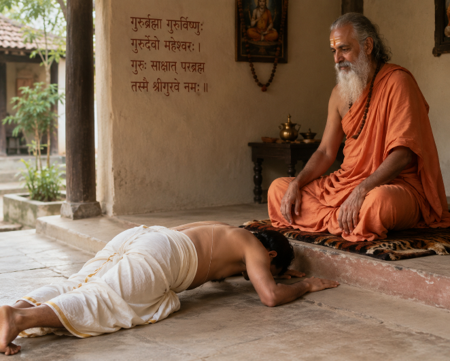
· Literal Meaning: "Prostration with eight parts."
Ashtanga Pranam (also known as Ashtanga Namaskara) is a core posture in traditional yoga, most famously practiced as the 6th pose in the classic Surya Namaskar (Sun Salutation) sequence.
The name is derived from Sanskrit:
· Ashta: Eight, Anga: Parts or limbs, Pranam/Namaskar: Salutation or bowing
In this pose, the body touches the ground at eight distinct points, making it a profound symbol of surrender, humility, and physical alignment.
From a plank or push-up position, you lower your body so that only the following eight points are in contact with the earth:
1. Both feet (toes tucked)
2. Both knees
3. The chest
4. Both hands (palms flat)
5. The chin (or forehead)
The abdomen and hips remain lifted off the floor, creating a slight arch in the lower back.
Ashtanga Pranam is far more than just a transition pose; it holds deep physical and spiritual meaning.
Physical Benefits & Mechanics
· Upper Body Strength: It builds fundamental strength in the arms, shoulders, and chest, acting as a stepping stone to Chaturanga Dandasana (Four-Limbed Staff Pose).
· Spinal Flexibility: The gentle backward arch tones the spine and improves flexibility in the back and neck.
· Respiratory Expansion: Pressing the chest to the floor while keeping the hips raised opens up the thoracic cavity, encouraging deeper breathing.
Energetic & Spiritual Significance
· The Ultimate Surrender (Humility): Bowing the head, heart, and body completely to the earth is an act of letting go of the ego. It represents a total surrender of one's thoughts (head), emotions (heart), and actions (limbs) to a higher consciousness or the universe.
· Chakra Activation: This pose primarily stimulates the Manipura Chakra (Solar Plexus), which is the center of willpower, vitality, and digestion, as well as the Anahata Chakra (Heart), fostering compassion and emotional balance.
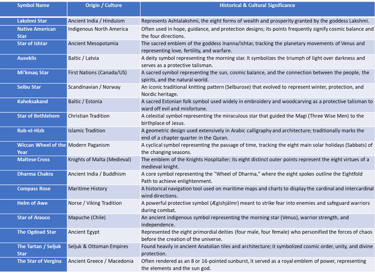
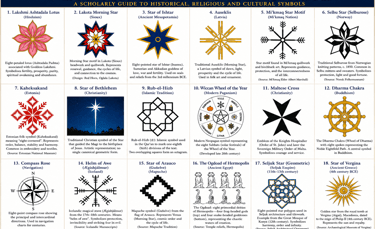
24. Eight Pointed Star (अष्टकोणीय तारा)
The eight-pointed star is one of the most universal symbols in human history, appearing across completely unrelated cultures, eras, and religions. Because it can be drawn by overlapping two squares at a $45^\circ$ angle, it carries a deep sense of geometric balance and symmetry.
Traditional & Historical 8-Pointed Star Symbols
25. Ashtakam (अष्टकम्)
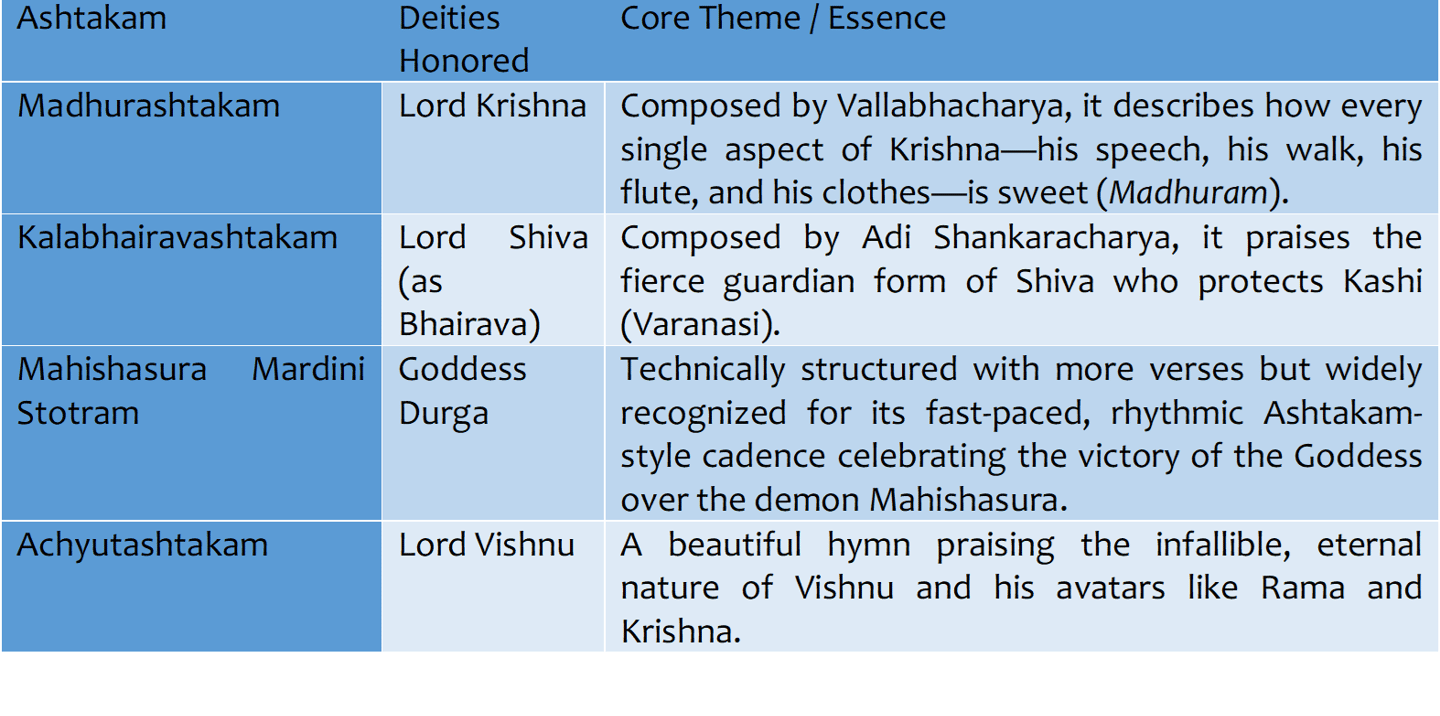
It is a traditional Sanskrit poetic form consisting of eight verses (known as shlokas or stanzas). The word is derived from the Sanskrit root Ashta, which translates to the number eight.
In Hindu devotional literature, Ashtakams are highly popular hymns composed in praise of various deities, embodying deep devotion (bhakti), philosophy, and intricate poetic rhythm.
Key Characteristics of an Ashtakam
· Strict Verse Count: A core Ashtakam contains exactly eight primary stanzas.
· The "Phalashruti" (Epilogue): While the main body has eight verses, you will often find a 9th stanza at the very end. This is called the Phalashruti, which explains the spiritual or worldly benefits a devotee receives by reciting the hymn.
· Refrain or Chorus Line: In most Ashtakams, the final line of every stanza repeats a specific phrase or prayer, acting like a spiritual chorus that reinforces the central theme.
· Metrical Rhythm: They are written in specific Sanskrit meters (like Anustubh or Bhujangaprayata) which make them highly lyrical, energetic, and easy to chant or sing.
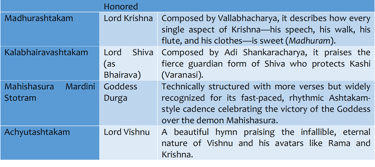
Many of the most famous Ashtakams were composed by the great 8th-century philosopher-saint Adi Shankaracharya. Here are a few widely chanted examples:
A Classic Example (From the Madhurashtakam)
To understand how it sounds, look at the opening stanza of the Madhurashtakam:
Adharam Madhuram, Vadanam Madhuram,
Nayanam Madhuram, Hasitam Madhuram.
Hridayam Madhuram, Gamanam Madhuram,
Madhur-Adhipater Akhilam Madhuram.
Translation: His lips are sweet, His face is sweet, His eyes are sweet, His smile is sweet. His heart is sweet, His gait (walk) is sweet—everything about the Lord of Sweetness is intensely sweet.
26. अष्टपदी (Aṣṭapadī / Ashtapadi)
Eight-verse hymn
Eight-stanza poem
Song of eight stanzas
Octet hymn (less common)
The Sanskrit breakdown is:
Aṣṭa (अष्ट) = eight
Padī (पदी) = verses, stanzas, or poetic sections
In the context of the Gita Govinda by Jayadeva, an Ashtapadi refers to a devotional song composed of eight stanzas, celebrating the divine love of Krishna and Radha.
गीत गोविंद की प्रसिद्ध अष्टपदी:
"ललित-लवङ्ग-लता-परिशीलन-कोमल-मलय-समीरे..."
यह भगवान कृष्ण की लीलाओं और भक्ति-रस का वर्णन करती है।
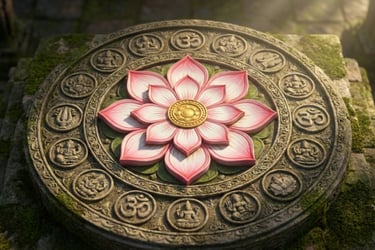
27. Ashtadal Padma (अष्टदल पद्म - Eight-Petaled Lotus)
The eight-petaled lotus is one of the most widely used ritual symbols in Vedic liturgy and meditation practice.
· Visual Description: A perfectly symmetrical lotus flower featuring exactly eight open petals surrounding a central seed pod.
· Significance:
o Cosmic Geography: The center represents the absolute source of creation (Brahman or Mount Meru), while the eight petals radiate outward to represent the cardinal and intercardinal directions of space guarded by the Ashtadikpala.
o The Human Body: In Tantra and Yoga, it represents the Anahata (Heart) Chakra or the Manipura (Navel) Chakra in specific traditions, symbolizing the unfolding of divine consciousness and emotional purity within the seeker. The lotus with eight petals is often integrated into sacred geometric diagrams (Yantras) and meditation practices.
o In temples like the Tirumala Venkateswara Temple, the Ashtadala Pada Padmaradhana is a famous weekly ritual. During this ceremony, 108 golden lotus flowers are placed at the feet of the deity, with each flower representing a specific divine name.
o In traditional Indian households, an eight-petaled lotus is drawn as a muggu (rangoli) in the puja (prayer) room during festivals like Diwali or Varalakshmi Puja to invite Goddess Lakshmi and invoke prosperity.
o The Celestial Abode in the Shri Yantra: Within the sacred geometry of the Shri Yantra (or Shri Chakra), the Ashtadal Padma is revered as the 'Sarva Samkshobhana Chakra'—the mystical circle of universal agitation—representing eight primordial energies of cosmic attraction and repulsion.
o The Seat of the Eight Divine Shaktis: Each of the eight sacred petals serves as an ethereal throne for a specific goddess or manifestation of divine power: Brahmi, Maheshwari, Kaumari, Vaishnavi, Varahi, Indrani, Chamunda, and Mahalakshmi, anchoring potent tantric energies within its form.
o Consecration of the Kalash and Deities: During grand Vedic sacrifices (Yajnas), sacred rituals, and the consecration ceremonies of divine idols (Prana-Pratishtha), this eight-petaled lotus is meticulously drawn using consecrated rice or vibrant powders. It forms the sacred foundation upon which the ceremonial Kalash (holy urn), the deities, or the sacrificial altar (Havan Kunda) are placed.
o The Rite of Divine Invocation: The lotus acts as a cosmic mandala; the supreme deity is invoked at its radiant center, while their eight celestial retinue or guardian deities are summoned upon the surrounding petals to receive worship.
According to the ancient science of Vastu Shastra, adorning the threshold of the main entrance or the floor of the prayer room (specifically the auspicious North-East direction, Ishan Kona) with the sacred motif of the Ashtadal Padma serves as a spiritual shield. It dispels malevolent energies, paving the path for an uninterrupted flow of celestial bliss, boundless prosperity, and serene harmony within the household.
28. Ashta Chiranjivi (अष्टचिरंजीवी)
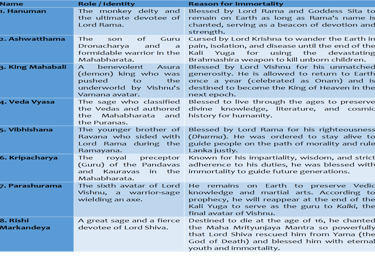
In Hindu tradition, the Ashta Chiranjivi (अष्टचिरंजीवी) are eight immortal personalities who are believed to remain alive on Earth throughout the current epoch (the Kali Yuga).
The word is derived from two Sanskrit words: Ashta (meaning eight) and Chiranjivi (meaning immortal or long-lived). Unlike Western concepts of immortality where physical bodies might be completely immune to time, these figures are blessed with exceptionally long lifespans, retaining their bodies and wisdom to guide humanity through different ages.
Here is a breakdown of the eight immortals, their roles, and why they were granted immortality:
The Eight Immortals (Ashta Chiranjivi)
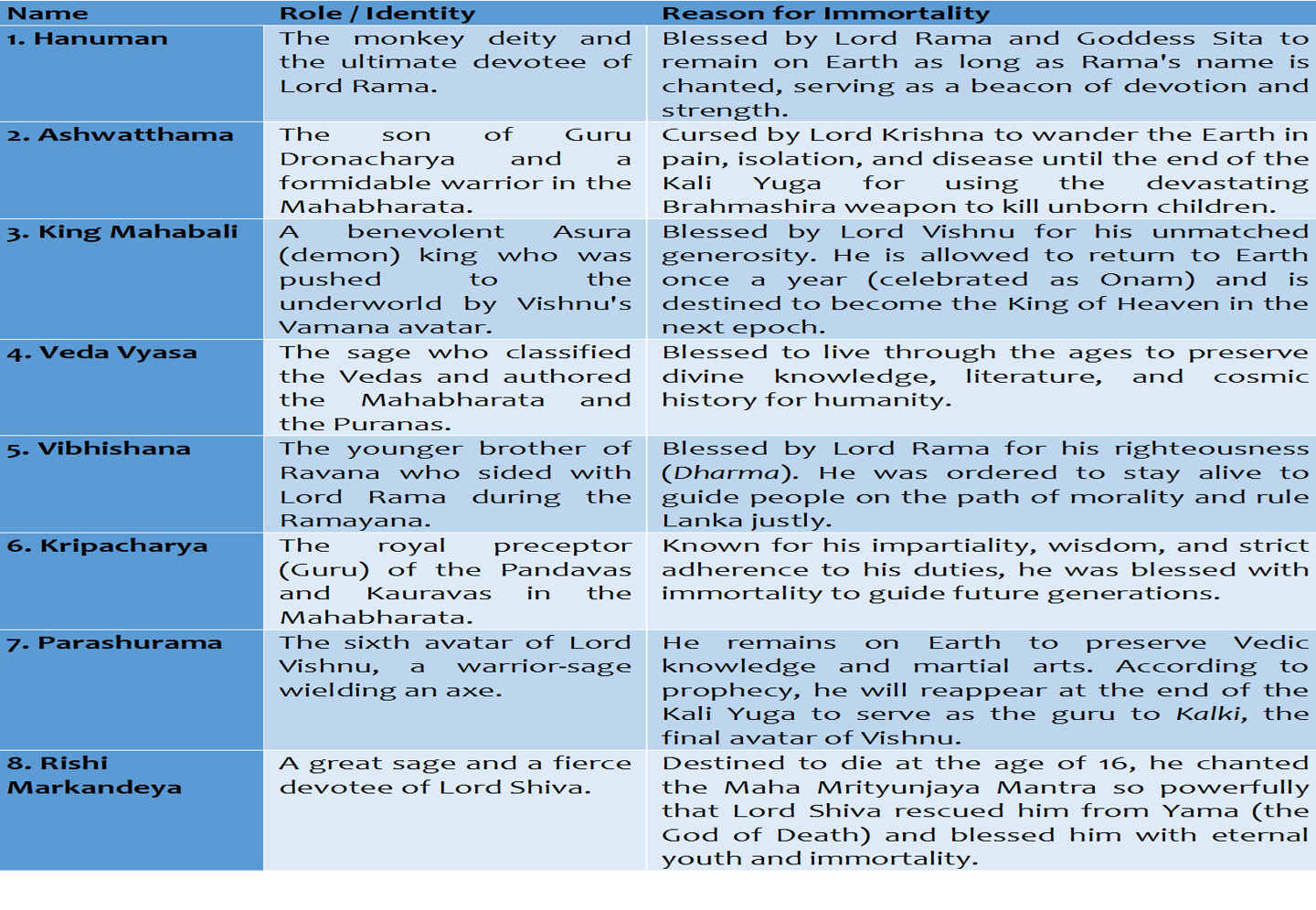
The Traditional Sanskrit Shloka - अष्टचिरंजीवी श्लोकः (Ashta Chiranjivi Shloka)
अश्वत्थामा बलिर्व्यासो हनूमांश्च विभीषणः ।
कृपः परशुरामश्च सप्तैते चिरजीविनः ॥
मार्कण्डेयस्तथाष्टमश्चैव सर्वव्याधिविनाशनम् ।
स्मरेच्छ्रेयः प्रवृद्ध्यर्थं जीवेद्वर्षशतं सुखी ॥
· अश्वत्थामा (Ashwatthāmā)
· बलिः व्यासः (Baliḥ Vyāsaḥ → combined as Balirvyāso)
· हनूमान् च (Hanūmān cha → combined as Hanūmānshcha)
· विभीषणः (Vibhīṣaṇaḥ)
· कृपः (Kṛpaḥ)
· परशुरामः च (Paraśurāmaḥ cha → combined as Parashurāmashcha)
· सप्त एते (Sapta ete → combined as Saptaite) चिरजीविनः (Chirajīvinaḥ)
· मार्कण्डेयः तथा अष्टमः च एव (Mārkaṇḍeyaḥ tathā aṣṭamaḥ cha eva → combined as Mārkaṇḍeyas-tathāṣṭamaś-caiva)
· सर्व व्याधि विनाशनम् (Sarva vyādhi vināśanam)
· स्मरेत् श्रेयः प्रवृद्ध्यर्थं (Smaret śreyaḥ pravṛddhyarthaṁ)
· जीवेत् वर्षशतं सुखी (Jīvet varṣaśataṁ sukhī)
"Ashwatthama, King Bali, Veda Vyasa, Hanuman, Vibhishana, Kripacharya, and Parashurama—these seven are the Chiranjiivins (immortals). Markandeya is the eighth. Remembering these names destroys all diseases, increases auspiciousness, and grants a healthy, happy life of a hundred years."
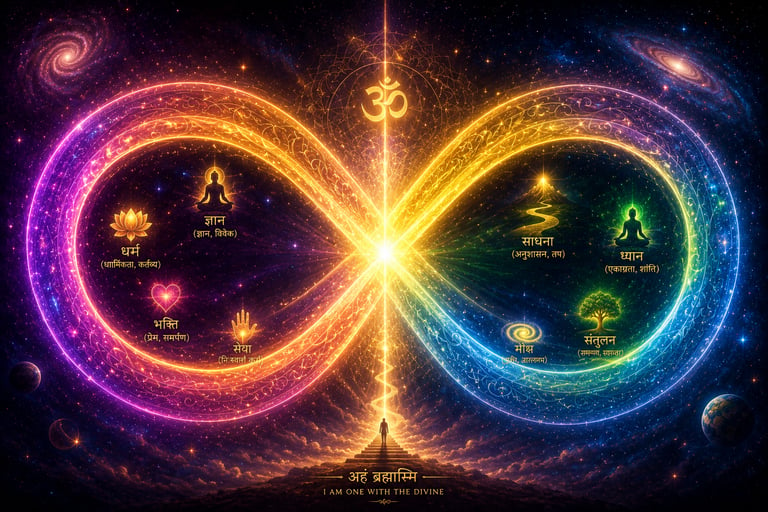
In Hindu Dharma and philosophy, the number eight [Ashta (अष्ट)] is not just a mathematical digit, it is a sacred symbol of wholeness, cosmic order, and spiritual completion. While the number three often represents the divine triad (Trimurti) and seven represents hidden mystical realms, the number eight represents the manifestation of the divine in the physical and spiritual universe.
In essence, Ashta signifies that nothing is left out. It represents a closed, perfect loop of creation, sustenance, and spiritual ascension, serving as a reminder that the divine manifests in a structured, balanced, and complete manner.
The repeated use of "eight" in spiritual traditions suggests:
Balance in all directions
Completeness of knowledge
Harmony between material and spiritual life
A fully developed path toward enlightenment
"अष्ट उस पूर्ण चक्र का प्रतीक है जिसमें सृष्टि, पालन, परिवर्तन और आत्मिक उत्थान के सभी चरण समाहित हैं।"
Disclaimer: All the images created are through AI tools. Therefore, there could be some errors. As much possible, care has been taken for no copyright infringement.
This site is better viewed on PC/Laptop