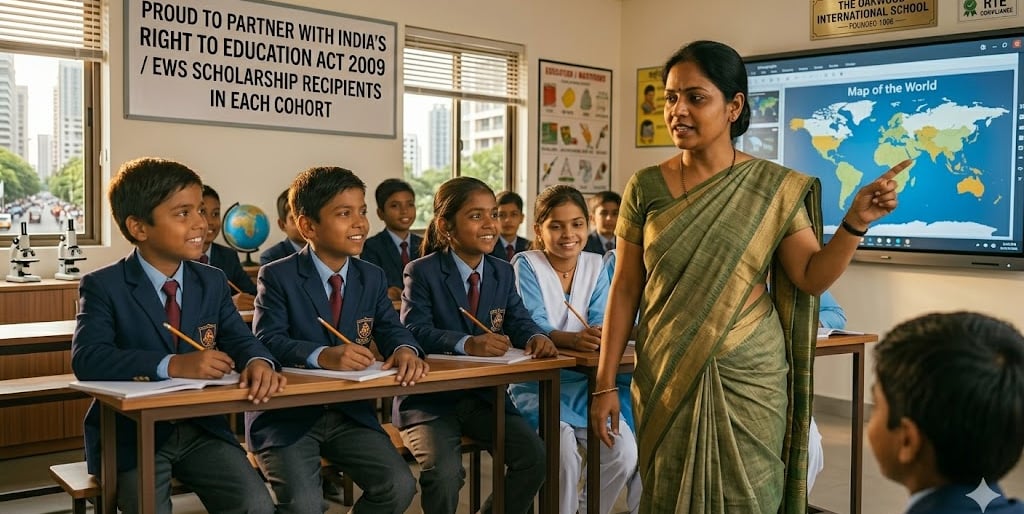

The Structural Metamorphosis of Indian Education: RTE @ 2026
The Right of Children to Free and Compulsory Education (RTE) Act, 2009, has long stood as the foundational bedrock of India’s elementary education ecosystem. By turning education from a distant policy goal into a justiciable Fundamental Right under Article 21A of the Constitution, it guaranteed free and compulsory schooling for children aged 6 to 14 years (Classes 1–8). However, by 2026, the landscape has radically shifted. The implementation of the National Education Policy (NEP) 2020 and the rollout of the NITI Aayog’s 2026 School Education Roadmap have initiated a massive structural evolution. India is rapidly moving away from an era of "expansion at any cost" toward an ecosystem focused on quality, consolidation, fiscal sustainability, and digital integration.
Anatomy of the Mandate: Core Pillars of RTE
To understand the current friction and transformations within the system, we must look at the key legal mechanisms that dictate how schools operate across the country:
· The 25% Mandate (Section 12(1)(c)): Private unaided schools must reserve 25% of entry-level seats for children from Economically Weaker Sections (EWS) and disadvantaged groups.
· Infrastructure Norms (Schedule): Strict baselines for Pupil-Teacher Ratios (PTR), separate hygienic toilets for girls and boys, safe drinking water, and dedicated playground facilities.
· Teacher Qualifications: Mandates clearing the Teacher Eligibility Test (TET) and strictly prohibits deploying teaching staff for non-educational tasks (exempting census, disaster relief, and election duties).
· The Screening Ban: Schools are legally barred from charging capitation fees or subjecting children and parents to structural screening interviews during the admission process.
· The No-Detention Reset (2019): While the original 2009 Act prohibited failing any student until Class 8, a critical 2019 amendment allowed states to reintroduce regular examinations in Classes 5 and 8. It gave state governments the discretion to detain students in these specific grades if they failed.
State-wise Impact on Schools and Ecosystem
The impact of RTE is heterogeneous, characterized by high enrollment in some states and severe infrastructure bottlenecks in others.
The Great Consolidation: Visualizing the Rationalization Phase
The data from the Ministry of Education's UDISE+ Dashboard (2024-25) and NITI Aayog (May 2026) highlights a striking paradox. While enrollment health remains strong at secondary levels, the sheer volume of physical public schools is shrinking. Over the last decade (2015–2025), approximately 93,779 government schools (roughly 9% of the national total) closed or merged. This shift is driven by "school rationalization"—policies aimed at merging under-resourced schools that see very low enrollment (frequently fewer than 20 students).
High-Decline Clusters (2020–2025)
According to the UDISE+ (Unified District Information System for Education Plus) series tabled in the Lok Sabha in February 2026, the net loss of 18,727 government schoolsoverthelastfiveyearshasbeenhighlyconcentrated.Thetablebelowdetails the top 10 states experiencing the sharpest corrections in absolute school numbers
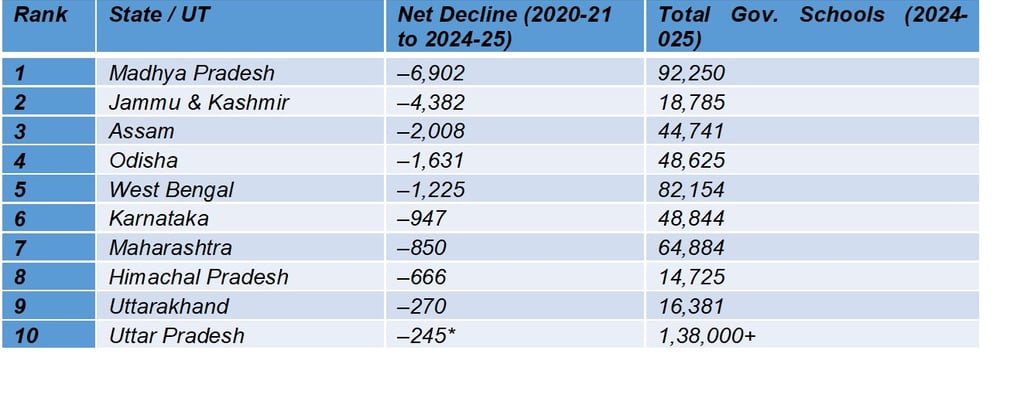
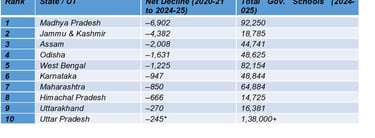
*Note: While long-term 10-year tracking indicates that Madhya Pradesh and Uttar Pradesh closed the highest absolute volume of schools over a full decade (approx. 30,000 and 25,000 respectively), recent years show a stabilization and plateauing effect in Uttar Pradesh, heavily driven by infrastructure upgrading under the national "PM SHRI" school network program.
State-Level Realities & The Budget Private School Crisis
The practical footprint of the RTE framework varies drastically across state lines, creating isolated pockets of intense administrative friction:
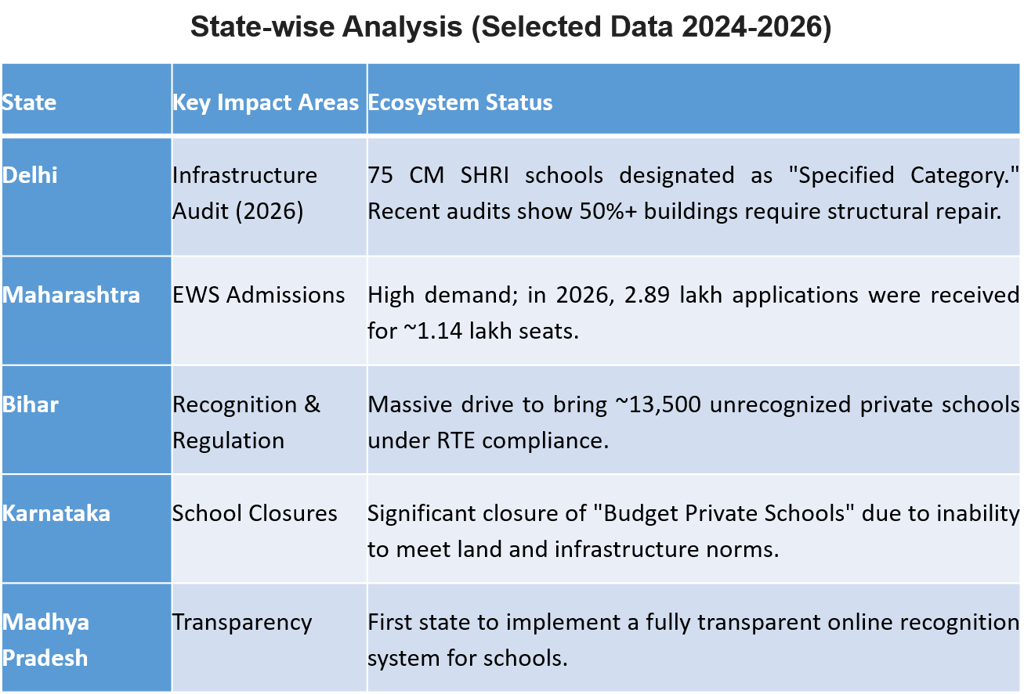
· Delhi (Infrastructure Audits): A 2026 systemic sweep of buildings revealed that despite 75 high-profile PM SHRI schools being designated as "Specified Category" hubs, over 50% of audited public school structures require immediate engineering and structural repair.
· Maharashtra (The EWS Bottleneck): Demand for the 25% private school reservation quota remains extraordinarily high. In 2026, the state recorded over 2.89 lakh applications competing for a limited pool of approximately 1.14 lakh entry-level seats.
· Bihar (The Unrecognized Sector): The state is currently executing a massive regulatory enforcement drive to bring roughly 13,500 previously unregistered private establishments directly under formal RTE compliance or face closure.
· Madhya Pradesh (Digital Transparency): On the positive side, MP has emerged as a pioneer by deploying the country's first fully digitized, end-to-end transparent online school recognition and validation platform.
The Budget Private School (BPS) Stress Test
While infrastructure mandates sound ideal on paper, they have triggered severe unintended consequences for small, low-cost "Budget Private Schools" (BPS). In states like Karnataka, strict enforcement of rigid land ownership and spatial footprint criteria has forced hundreds of neighbourhood low-fee schools out of operation. As per NITI Aayog (2026), teacher vacancies remain a challenge, with a high concentration of single-teacher schools in rural Rajasthan and Uttar Pradesh
Many of these micro-schools operate out of tiny, rented structures within dense urban slums where physical expansion is mathematically impossible. Despite often matching or exceeding the localized learning outcomes of nearby public institutions, these schools are forced to shut down because they lack the capital to buy mandated land plots or match state-specified teacher pay scales.
Compounding this crisis, persistent delays in state governments reimbursing private schools for taking in EWS quota students have broken the cash flows of thin-margin schools, leading to widespread financial insolvencies.
The Jurisdictional Boundary: Who Lies Outside RTE?
The applicability of the RTE Act is determined by a school's funding source and its "minority" status. It is a national mission, but structural exemptions protect specific constitutional entities:
A. Minority Institutions (Religious & Linguistic)
Protected under Article 30(1) of the Constitution and solidified by the landmark Supreme Court ruling in Pramati Educational and Cultural Trust v. Union of India (2014), minority-run institutions (both aided and unaided) are fundamentally exempt from enforcing the 25% EWS reservation quota. The apex court ruled that forcing external quotas onto minority schools directly violates their constitutional right to self-manage and protect their distinct cultural character.
The 2026 Boundary: While exempt from EWS quotas, minority schools are not exempt from basic student safety codes, building structural regulations, or mandatory teacher certification standards (TET).
B. Vedic Pathshalas, Madrasas, and Religious Centers
Institutions primarily dedicated to delivering religious instruction are explicitly excluded from the core mandates of the Act under Sections 1(4) and 1(5). They are not required to adopt the National Curriculum Framework (NCF) or reserve seats. However, if a Madrasa or Pathshala decides to offer an integrated stream of "formal education" mapped directly to State or CBSE boards, it falls under state regulatory oversight for those subjects while retaining its quota exemption.
C. Home Schooling and Alternate Learning Systems
The RTE Act does not explicitly codify or validate "Home Schooling" frameworks. In practice, however, authorities do not penalize parents for home education, provided core learning milestones are met. For students aged 14 and above, bodies like the National Institute of Open Schooling (NIOS) offer an alternate, highly flexible path that operates completely outside the physical "neighborhood school" structure of the RTE.
The Policy Horizon: 2026 to 2030
As India navigates the remainder of the decade, the NITI Aayog policy roadmap outlines several key regulatory shifts designed to transform the current elementary landscape:
From Input-Based to Outcome-Based Regulation
Regulators are shifting away from punishing schools over rigid physical dimensions (like playground size or plot layout). Future amendments will favour performance-driven recognition tied directly to standardized foundational literacy and numeracy metrics (PARAKH scores). Schools delivering high-quality learning outcomes within tight urban settings will receive "provisional recognition" pathways, provided they pass strict structural safety inspections.
Overcoming the "RTE Cliff"
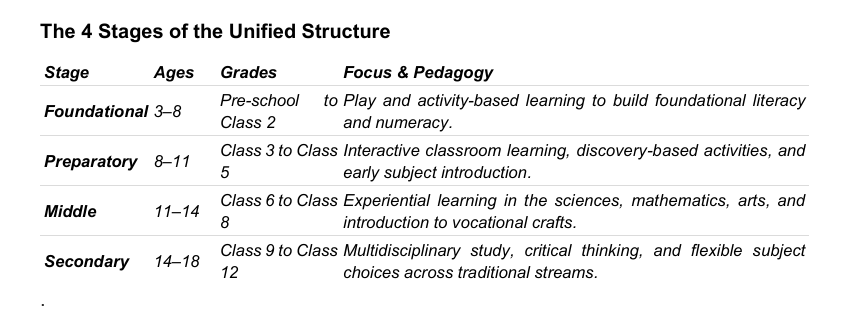
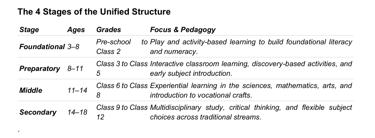
Currently, the legal right to free education ends abruptly at Class 8 (age 14). This creates a steep drop-off point where thousands of vulnerable EWS students lose financial assistance and drop out between Classes 9 and 10. Policymakers are facing mounting legislative pressure to officially extend the RTE umbrella up to Class 12 (age 18), aligning it with the unified 5+3+3+4 curricular structure of the NEP. This would prevent the massive "Class 9 dropout" seen among EWS students who currently lose their 25% quota support after middle school, gender discontinuity and economic exclusion.
The School Complex Model vs. Remote Commute Friction
To counter fragmented public schooling, states are actively grouping clusters of small foundational schools around a well-equipped central secondary school. This allows specialized science teachers, computer labs, and athletic fields to be shared effectively across a larger group of students.
However, this structural adjustment brings real real-world challenges in geographical terrains like Uttarakhand, Himachal Pradesh, and Jammu & Kashmir. Closing micro-schools in mountainous areas increases the physical commute distance for children, leading to noticeable increases in localized drop-out rates among rural girls aged 11 to 14. Balancing centralized school resources with safe, accessible local transport remains one of the critical challenges for Indian education heading toward 2030.
Digital Hybridity
The closure of physical schools in remote areas is being mitigated by PM e-Vidya and digital outreach. By 2030, the "neighbourhood school" may not just be a building, but a hybrid hub where local students access high-quality lectures via satellite or high-speed internet.
Key Remedies and Amendments to Reopen Closed Schools
To revive the "closed school" ecosystem—particularly low-cost private schools—experts and statutory bodies suggest a shift from Input-based to Outcome-based regulation.
Proposed Amendments
Amendment to Section 18 & 19: Shift the focus from "minimum land and building requirements" to "safety and learning outcomes." Schools that provide quality education in smaller spaces (common in urban slums) should be granted recognition if they meet safety codes.
Direct Benefit Transfer (DBT) for RTE Reimbursement: Delays in State payments to private schools for the 25% quota have caused financial collapse. An amendment to mandate DBT directly to schools or parents would stabilize their finances. A DBT model can improve transparency, accountability, sustainability.
Grade-based Recognition: Instead of permanent closure for non-compliance, introduce a "Provisional Recognition" period (3–5 years) with a roadmap for improvement.
Integrated Complex Model: Allow small schools to share playgrounds or laboratories with neighbouring Government/larger Private schools to meet infrastructure requirements collectively.
Toward a High-Performing Future
The structural metamorphosis of the Right to Education ecosystem in 2026 marks a decisive shift in India’s national strategy. The country has successfully achieved its initial baseline goals: physical access to schooling is near-universal, and basic infrastructure metrics—like separate functional toilets for girls and boys—now exceed 98% national coverage.
However, the "rationalization phase" has revealed that the next frontier of educational equity cannot be won by simply counting school buildings. The closing and merging of nearly 94,000 schools over the last decade is not a retreat from the promise of Article 21A, but a consolidation of strength. By transition from fragmented, single-teacher
institutions to robust, resource-rich School Complexes, the administrative architecture is aligning with the qualitative demands of the National Education Policy.
To ensure this transition does not leave vulnerable demographics behind, the regulatory framework must continue to adapt. Resolving the "RTE cliff" by extending free education to secondary levels, introducing Direct Benefit Transfer (DBT) mechanisms to stabilize the fragile budget private school ecosystem, and using outcome-based recognition (PARAKH scores) over rigid spatial inputs will be vital. Ultimately, the evolution of the RTE Act post-2026 should drive toward a leaner, smarter, and highly efficient network—ensuring that every surviving classroom functions not just as a statistical unit, but as a genuine incubator for learning.
The RTE Act remains one of the most transformative social legislations.However, the future of Indian education depends on balancing:
· access with quality,
· inclusion with sustainability,
· regulation with flexibility,
· infrastructure with learning outcomes.
The next generation of reforms is likely to move toward:
· outcome-based governance,
· integrated school ecosystems,
· expanded digital education,
· and possibly universal free schooling up to Class 12.
India’s education system is not shrinking; it is restructuring.
The Right to Education (RTE) Act of 2009 was built for physical enrollment and an industrial economy. To prepare India for an AI-driven, climate-conscious future, the legal framework must pivot from "physical schooling" to "cognitive capability and digital equity."
A blueprint to amend the RTE for a futuristic India.
1. Expand the Age Bracket (Ages 3 to 18)
The Change: Amend Section 3 to expand free, compulsory education from the current 6–14 age bracket to 3–18 (Preschool through Class 12).
The Impact: Secures early childhood brain development (ages 3–6) and legally prevents high school dropouts, aligning the law with the National Education Policy (NEP).
2. Redefine Infrastructure as "Digital Sovereignty"
The Change: Upgrade Schedule 1 from purely physical metrics (playgrounds, boundary walls) to include Digital Infrastructure—guaranteeing high-speed internet and an affordable computing device as a constitutional right.
The Impact: Dissolves geographical barriers, allowing high-quality, hybrid learning to reach rural and tribal students instantly.
3. Shift from Grade-by-Age to Competency-Based Learning
The Change: Replace rigid annual grade progression with Competency-Based Advancement, legally integrating hyper-personalized AI tutors to adapt to each child's learning speed.
The Impact: Eliminates the "learning deficit" epidemic where children advance to higher classes without mastering foundational concepts.
4. Mandate a "Future-Proof" Core Curriculum
The Change: Codify three non-negotiable literacies into the national curriculum:
Digital & AI Literacy: Data hygiene, basic coding, and prompt engineering.
Financial Literacy: Digital economy navigation, micro-investing, and tax basics.
Climate Resilience: Sustainability and green-tech adaptation.
The Impact: Transforms India's youth demographic from vulnerable gig-workers into resilient creators in an automated global economy.
5. Modernize Teacher Frameworks & Tracking
The Change: Transition from administrative box-checking to dynamic ecosystem tracking:
[Current RTE Focus] [Futuristic Shift]
Physical 30:1 Ratio ───► Hybrid Mentorship (AI Assistants + Teachers)
Static B.Ed. Degrees ───► Continuous Micro-credentials in Digital Pedagogy
Paper Progress Cards ───► Blockchain-backed "Academic Bank of Credits"
The Core Vision: RTE 2.0 must shift its goal from putting every Indian child inside a classroom to giving every Indian child an equal, uncompromised launchpad into the global digital economy.
_________________________________
Resources & References :
· Ministry of Education (MoE): dsel.education.gov.in (For RTE Rules, Amendments, and Notifications).
· NITI Aayog: School Education System in India: Temporal Analysis and Policy Roadmap 2026 report.
· Legislative Department: legislative.gov.in (For the original 2009 Act and 2019/2024 Amendment text).
· UDISE+ (Unified District Information System for Education): For real-time state-wise school data and infrastructure statistics.
· National Council of Educational Research and Training (NCERT): For curriculum alignment under Section 7 of the RTE Act.
· Times of India Education. (2026, February 5). Five years, 10 states: Where India's government school count fell the most. timesofindia.indiatimes.com
· Careers360. (2026, February 12). 93,000 Schools Closed in 10 Years, One Uncomfortable Question. school.careers360.com
· AI tools
E&OE
Core Eligibility Criteria under the RTE (Right to Education) Act for EWS (Economically Weaker Section) admissions
Nursery (Pre-School): 3 to 5 years
KG (Pre-Primary): 4 to 6 years
Class 1: 5 to 7 years
Age Relaxation: Children with disabilities (CWSN category) get an age relaxation of up to 2 years for each entry-level class.
Income Limit: The family’s total annual income must fall below the state-prescribed threshold (typically varying between ₹1 Lakh to ₹1.5 Lakh per year, depending on the state). Families applying under the EWS category must have a total annual income of less than Rs. 5 Lakh in Delhi. {National Norms: Generally, the family income should be less than ₹1,00,000 to ₹8,00,000 annually, depending on state-specific guidelines.)
Local Resident: The child and family must be a resident of the state or local municipal area where the school is located. Admission priority is generally given to children who live within a specific radius of the school (often 0 to 3 km)
Aside from the Economically Weaker Section (EWS), the mandate covers Disadvantaged Groups (DG). The complete umbrella includes:
Children from EWS families
Children belonging to SC, ST, or OBC (Non-Creamy Layer) categories
Orphans or children without legal guardians
Children with disabilities (40% or more)
Children affected by HIV or whose parents are affected
Children of single parents, transgender individuals, or marginalized communities
Documents Required
Proof of Date of Birth: Child’s Birth Certificate (issued by a municipal authority, hospital, or Anganwadi record).
Income Proof:
A valid Income Certificate issued by a competent Revenue Authority (Tehsildar or SDM).
OR a valid Below Poverty Line (BPL) / Antyodaya Anna Yojana (AAY) / Food Security Card.
Residential Proof: Aadhaar Card, Voter ID, Ration Card, or utility bills in the name of the parents or child.
Identity Proof: Aadhaar Card of the child and both parents.
Passport-Size Photographs: Recent colored photographs of the child.
Additional Documents (If Applicable): Legal guardianship documents or death certificates of parents (if the child is an orphan/under legal guardianship)